Archive | Recipes RSS feed for this section

Delicious and easy marmalade-y sausages

20 Jul

I like sausages. And I now like marmalade. For most of my life only one of those sentences has been true. I’m glad that they both are now.

So, since I like marmalade, it seems sensible to start using it in recipes. And I’ve started easy peasy. What could be easier than sausages?

My local butcher is worth visiting. He is a good old-fashioned Scottish butcher, with lots of bacon and steak pies and haggis and black pudding. And all other lovely meaty things. I’d intended to make Scotch Eggs this weekend with our glut of lovely fresh eggs from my ladies. But somehow that didn’t happen. So, this evening there were sausages to be eaten. We dug up some potatoes from the veg bed, to go with the sausages.

Marmalade sausages

Oven: Gas Mark 6

  • half a dozen small-ish pork sausages (or a couple of big ones)
  • 2 big spoonfuls of marmalade
  • 1 spoonful of tomato ketchup
  • 1 spoonful, or a big slug, of sunflower oil, or rapeseed, or vegetable oil, whatever you have to hand
  1. Mix together all the ingredients, apart from the sausages.
  2. Roll the sausages in the marmaladey mixture to entirely cover them up
  3. Pop each smothered sausage onto an oven tray, preferably one of those ones which has a ‘well’ for all the juices to run into
  4. Put them in the pre-heated oven, and leave for about 25 mins

Serve with new potatoes, savoy cabbage and onion gravy. There, how easy was that?

Oh, and if you feel like making your own marmalade too, try this: Tasty orange ginger marmalade.

Perfect salad for when you have the best tomatoes

28 May

You already know that I love buying and cooking and eating local food. So when Clyde Valley Tomatoes were back at my local farmer’s market earlier this month, I knew we’d be eating tomatoes all week!

I wanted to make a salad which would showcase the varieties of tomatoes.

Spring haul from farmer's market

Spring haul from farmer’s market

On the drive home I thought of a salad I used to make many years ago: fattoush. And then another tomato and stale bread salad: panzanella. I hadn’t made either for years, and started hankering for that melding of flavours and textures. Yes, these tomatoes were destined to become one big dish of delicious salad. Served with cold meats for lunch.

Panzanella

  • 1 small onion, thinly sliced and left in a bowl of ice cold salted water for an hour
  • 1 red pepper
  • 1 yellow pepper
  • a punnet or two of ripe tomatoes from Clyde Valley Tomatoes. Or perhaps about 8 medium tomatoes – if you’re using wee ones, feel free to double the quantities
  • 200g stale(ish) sourdough bread
  • 4 TBsp white wine vinegar
  • 1 TBsp capers
  • 2 anchovies, finely chopped
  • 6 TBsp extra virgin olive oil
  • small bunch of fresh basil
  1. Cut the peppers into big flattish pieces and pop them under a grill skin side up so the skin blackens. Alternatively use a toasting fork (who has such a thing these days?) and burn the skin over a gas hob, or chuck them in a hot oven. Or use a blow torch. You’ll know how you like to do it. Once the skin is black, put the pieces of pepper into a bowl and cover with cling film for 20 minutes or so.
  2. Cut the tomatoes into large chunks and place in a colander over a bowl. Sprinkle some salt over them and leave to drain while you prepare everything else
  3. Cut (or tear) the bread into chunks, about the same size as your tomato chunks and put them into a salad bowl and drizzle with vinegar
  4. Drain the onion and add it to the salad bowl
  5. Add the capers
  6. By now your peppers might be ready for peeling, so peel off the black skin, or as much of it as you can and cut the pieces of naked pepper into strips. Put them in the bowl
  7. Press down on the tomatoes and squeeze out lots of juice, then put the tomato flesh into the salad bowl
  8. Add the chopped anchovies and olive oil to the tomato juice and whisk
  9. Add salt and pepper to taste
  10. Pour the dressing over the salad and toss. Pick off some basil leaves and tear them onto the salad
  11. Leave for 15 minutes or so at room temperature – or outside in the sunshine
  12. Serve as one of those lunches where the table is covered with bowls and plates and ashets of this and that tasty treats.

Of course you could skimp some of the steps or tweak the recipe as you go:

  • If you don’t soak the onion right at the beginning, it will taste too harsh (for my taste buds). You might prefer to use red onion, or spring onions
  • Don’t bother pouring the vinegar over the bread. I think you’ll regret missing out that step though!
  • Add garlic. In fact most recipes include garlic. I just forgot to add is when I made it and enjoyed the garlic-free breath, and how the other flavours all sung out at me
  • Add cucumber, celery, chilli, crisp lettuce
  • Omit the anchovies if you’re feeding vegetarians. Obviously!

Basically make this your own panzanella – so long as you have the very best tomatoes and some good quality bread, you’ll make something delicious.

No pictures though, we ate it too quickly!


Rhubarb marmalade

30 Apr
Rhubarb marmalade

Rhubarb marmalade

I love my local farm shop. Let me give it a shout out.. it’s at Overton Farm in the Clyde Valley. Given the choice between spending a wee bit more per item at the farm shop, or spending a whole lot more in total (because I go off-list and end up buying things I don’t really need at the supermarket) I now always choose the farm shop. This means I more regularly run out of stuff like dry cat food, or domestos, but that’s ok. We have a car, and most things can wait till the weekend.

The farmshop isn’t exclusively local, so year round it’s possible to get those things that were seasonal treats in my childhood – peppers, mangoes, and even pears. But I like seasonal, and I have an urge to put things in jars when they are in season. Some time soon I am going to write a list of all the things I have in jars, so that I’m more likely to use them… they live in a drawer in a filing cabinet in a cupboard under the stairs. Yup, not really in an obvious place so I see a jar of, say spiced damsons, and think ‘that will go perfectly with the smoked mackerel I’ve just bought impulsively at the supermarket because we needed dishwasher tabs’. In fact I might just do that later this afternoon – I have the day off, and had planned to garden, but it’s grizzly grey weather and I’m something of a fairweather gardener, shaming though it is to admit that.

Anyway, back to seasonal and local and all that jazz. My seasonal treat at the farmshop on Saturday was a big bunch of rhubarb. I LOVE rhubarb; it’s that tart sharpness that just zings for me.

Thane Prince is one of my go to writers for any sort of a preserve. She currently can be seen in the BBC’s Great Allotment Challenge programme, but honestly I wouldn’t recommend that as your first experience of her. Watching someone, anyone, spooning out 10 globs of chutney from a jar and then tasting it, and diluting ten lots of cordial in water and sipping it is not my idea of good TV, no matter how lovely she may be, or how erudite her comments and criticisms are. Please BBC, try harder.

But of course she has a lovely recipe for Rhubarb Marmalade, with or without ginger. And that is what I settled on. Fortuitously I had just the right quantities of everything: rhubarb, sugar, oranges, pectin. And ginger. Why would I make it without ginger?

Rhubarb marmalade

From Thane Prince’s Jellies, Jams and Chutneys.

  • 1kg rhubarb, washed and cut into even 1cm wee chunks
  • 800g sugar
  • 2 large oranges
  • 125g liquid pectin
  • about 3cm fresh root ginger, grated. You do have a ginger grater don’t you?
  1. Get prepared. Put a large plate into the fridge, so you can check for a set when the time comes
  2. Clean your jars in hot water, and pop them in a low oven to sterilise them
  3. Zest your oranges, and then juice them
  4. Put the rhubarb, sugar, orange zest and juice into a heavy non-reactive pot. Bring the mixture slowly to the boil and then simmer over a low heat for 5-8 minutes. The rhubarb should be soft and the sugar dissolved.
  5. Turn off the heat for a minute. Add the pectin. Stir gently so it’s all mixed in and then turn the heat back up. Bring to a good boil and cook for a further 2 minutes before testing if it’s set. At this stage my marmalade was still incredibly runny and it took a further 25 minutes before it started looking properly jammy and was anything near a set. And then of course it went just too far and my marmalade is just slightly more solid than I would like – I like it still squelchy.
  6. Once the marmalade has reached setting point, ladle it into the hot sterilised jars, seal and label.

You do know how to test for a set don’t you? I wouldn’t recommend using a sugar thermometer for this recipe – when my marmalade had reached setting point it was still far off the ‘jam’ stage on my thermometer, which is no doubt to do with the levels of pectin in the mix. Anyway, I test for a set by dropping a wee gob of the hot marmalade onto a cold plate (yes, that one you put in the fridge right at the beginning); leave it a wee second or two, and then push it with your finger. If it wrinkles it’s ready (or even over-ready); if it is just liquid and runs back into a puddle it needs more boiling.

So, why would anyone spend their Sunday afternoon making Rhubarb Marmalade? Easy… just try it, still warm on hot buttered toast. You will forget that anything else exists, and you’ll wish that you could do this every afternoon, and if you’re feeling special match it with a wee glass of fizz. My accompaniment was a perfect cup of Earl Grey tea, out of a fine china tea cup. Deliciousness.


Janssen’s Temptation

5 Jan

You’ll have heard of this recipe before, you may even have eaten it, and made it.

For me, it’s one of those go-to recipes when I’ve bought cream for something and then either forgotten what it was I bought it for, or just have loads left over. Or changed my mind. After all, what would be nicer than fillet steak with creamy potatoes? And brussels sprouts? OK, you might not all agree with the addition of the brussels as a side dish, but I’ve learned to love the wee critters. My spiced pickled red cabbage on the side would have created perfection on a plate, but I forgot it when I was serving up. I forgot to turn the oven off too.  So, it could have been the second time in 24 hours the house nearly burned down.

Yes, it’s been an eventful time.

We were relaxing in front of the fire (with a cheese board and some vintage port) when we noticed a car drawing up outside (we live far from anywhere, but beside a road, so notice these things on the rare occasions they happen). Then there was a knock at the gable window, beside where I was sitting. I couldn’t see who it was in the dark blackness outside. The Captain went out to investigate and asked if I was cooking anything when he went through the kitchen… but no, I wasn’t. And then we discovered that the kind stranger had stopped to inform us our wheelie bin (right beside our boiler and the side of the house) was on fire. It was seriously on fire, with flames shooting out of it and 3/4 of the bin now melted away. It was cold and dark and windy, with a drizzly rain spattering down on us. The boys pulled out the hose (not melted by the heat of the fire) and we spent the next half hour making sure the bin had no chance of bursting into flame again.

We’ll never know for sure what caused the fire, but suspect it may have been our house guest who had lit a fire earlier in the evening and burned lots and lots and lots of paper. The next morning she asked if it had been because she’d put hot ash in the bin. As I say, we’ll never know for sure.

Anyway… the next evening I attempted (yet again) to use up some more of the ingredients I’d bought in for the Christmas season, and it was time to finish that enormous pot of cream. I much prefer savoury to sweet (despite the huge number of recipes for sweet homebaked goods on this site) so decided on Janssen’s Temptation, that delicious potato gratin dish, baked in the oven till it’s all oozingly unctuous.

Janssen’s Temptation

  • A large pot of double cream
  • About the same amount of milk
  • A few large potatoes
  • An onion (or several if you are feeding the five thousand)
  • Anchovy fillets (although I’m reliably informed that this is WRONG and that it should be sprats, it’s just that we are a bit rubbish at translating Swedish and have translated ‘ansjovis’ which means sprats into anchovies… well, you would wouldn’t you?)
  • Some veg stock (or a cube, crumbled)
  • Seasoning
  • Some butter

I know, I know, I’ve not been too precise on the quantities here, but since I only ever make it when I’m using up what’s left int he fridge, how would I really know?

Preheat oven to 220C/400F/GM6

  1. Slice your onion (I always slice it in half long ways, and then put it on it’s flat side and slice it into thin crescent slices)
  2. Pop a dod of butter into a large heavy based frying pan and gently fry the onion over a low heat, till they are sort of soft-ish
  3. Butter a gratin dish. You choose the size, depending on the number you intend to feed and how many potatoes/onions you have
  4. If you’ve got a mandolin, slice your potatoes nice a thin. If you haven’t then you’ll take a bit longer over this bit, doing it with a sharp knife. If you don’t have a sharp knife or a mandolin then don’t even think about trying this recipe.  Go and buy a decent knife and a knife sharpener and then come back and get started
  5. Chop up some anchovy fillets. A whole tin if you’ve got it, or if you’ve got them in a big jar in the fridge, then chop as many as you fancy – you’ll need to add a few to each layer (see below)
  6. Place a layer of potatoes on the bottom of your gratin dish
  7. Add a think layer of onions
  8. And some anchovies and freshly ground black pepper
  9. Repeat this layering another one or two times, ending with a layer of potatoes
  10. Mix your cream with milk, roughly half and half. Add some veg stock if you have it, otherwise crumble in a veg cube
  11. Pour most of this over your potato layers, so it’s roughly half way up the side…
  12. Pop it in the oven and leave it for a good 20-30 minutes. Pour yourself a cocktail. You probably deserve it.
  13. Take it out of the oven and wonder at how tasty it smells and looks. Pour the rest of the cream mixture over it. And pour yourself another cocktail.
  14. Leave it in the oven for another 20-30 minutes, till it is soft all the way through when you poke it with a knife. You may need to turn the oven down a bit and leave it longer if you’re enjoying the cocktails too much and haven’t put your steak on yet. Or if you were sensible you would have made a stew the day before which just needs re-heating and no further cooking would be required.

And that’s it. Tastiness on a plate. You’d have photos if I hadn’t had cocktails.

I could give you a photo of the melted wheelie bin, but really, it would put you off all your meals in 2014.

Happy New Year everyone.

Better than Patatas Bravas

20 Oct

Potatoes. So versatile. What’s not to like about them? Well, apart from the fact that they are full of carbs and it’s oh so easy to fall into the trap of mashing them with lots of butter and/or cream or frying them oil or roasting them in goose fat. Yeah none of them will help reduce the waistline.

In Scotland we call them tatties. And this last week has been the tattie-howking holidays, although everyone I mentioned that to looked back at me blankly. I realise that we no longer put children to work in the holidays (and in fact in my childhood we were never put to work either) but still, surely kids should know that they traditionally get the week off at this time of year to help with the harvest, rather than just to give the teachers a much-needed break not two months after they’ve come back from their extended summer break.

So, in case I’ve lost you, tattie-howking means ‘digging up potatoes’.

What else can I tell you about tatties, before I move on to the recipe? Given that you’re about to get a Spanish recipe I could  do a neat wee segue-way with some Spanish related history of the potato. It seems likely that the English word derives from the Spanish patata. It was the Spaniards who brought the potato to Europe, in the second half of the 16th century after conquering the Incas. Initially European farmers were sceptical about the crop, but by the mid 19th century it had become a staple food crop. However, very few varieties had been introduced to Europe and this lack of genetic diversity meant that in 1845 the fungus-like disease of blight could spread wipe out vast crops and cause the Irish Famine.

So, a diversity of species is important, not just for flavours and fun, but because it could prevent further famines caused by crops being wiped out. Put that in your GM pipe and smoke it.

We had the day off on Monday, and went into Glasgow to see the Vettriano exhibition which I loved. And I’m not ashamed to say I love his work – there were images we’ve all seen in countless reproductions. But the originals have more depth and the colours in some really zing out, while in others there is such a dark broody moodiness you can almost feel the sexual tension in the air. And then there were many many images I had never seen before: his lady in a black hat as a nod to Cadell; his self portrait taken from a photograph of himself when he was in a dark black place; his paintings of Campbell and the Bluebird about to attempt the world speed record: a series of nautical paintings, commissioned for some anniversary of some place in Monte Carlo or Monaco or some other such place dripping with money.

Afterwards I was hungry, and the cafe at the museum was full so we ended up at a (rather mediocre) tapas bar and ordered some plates to share. The Patatas Bravas was the stand out dish, full of flavour and punch with melt in the mouth potatoes and a strong tomatoey sauce.

I was inspired to make a tapas style meal the next day, and it had to include a Patatas Bravas element (and many many scallops after I found a bag of them reduced in my local supermarket, oh how I wish I had a decent fishmonger!). But I came across a recipe for Patatas a la Extremena which looked tasty and included nothing but ingredients I happened to have already in the fridge or cupboards. So that is what I made. They come from the Extramedura region of Spain and are flavoured with lots of smoky paprika (or pimenton). I added a good dose of ancho chilli too, because I love the layers of flavour you can get when playing with various spices.

I could tell you lots about paprika, but we’ll save that for another day. All you need to know for now is that it probably originated in South America, like those potatoes.

Patatas a la Extremena (which in my head I always call Extreme Potatoes)

Based on a recipe from Sophie Grigson in her wonderful book, Spices.

  • About 4oz / 250g chorizo sausage (the whole sausage kind, not slices), cut into wee chunks
  • 3 or 4 large potatoes (or more medium ones, obviously), cut into about 1.5″ chunks
  • 1 red pepper, deseeded and chopped into long strips
  • 1 green pepper, deseeded and chopped into long strips
  • 3 garlic cloves, peeled and chopped finely, or smooshed up
  • 1 TBsp smoky paprika
  • 1-2  tsp ancho chilli flakes – get them from the Cool Chile Co
  • 1 bay leaf
  • seasoning
  1. Get your biggest heavy bottomed, high-sided frying pan you have. There must be a name for them, but I don’t know it. If you don’t have such a thing, then I’d suggest either using the largest frying pan you have combined with a roasting dish, or a large saucepan. Or reduce the quantities so everything will fit into the frying pan you have.
  2. Over a medium heat, fry off the chorizo until it’s lightly browned. Lots of fat will melt out of the chorizo, but if you feel you need to add olive oil, then do.
  3. Reduce the heat, and add all the other ingredients
  4. Stir around for a minute or two with a wooden spoon – try not to break up the veg, so use a sort of scooping motion, picking the veg from the bottom of the pan, and then folding it over onto the top of the pan. then moving around the pan and doing it again
  5. Pour in enough water to cover the veg, bring to the boil and simmer nice and gently. Now, if you’re using the smaller pan and the roasting tin, you should have tipped your veg into the roasting tin before adding the water on top, and then popped it all into a pre-heated oven.
  6. Simmer for about 30 minutes, stirring occasionally, but being careful not to break up the potatoes too much.
  7. Test that the potatoes are cooked, and make sure your sauce has reduced down enough so that it is thick enough. If it hasn’t, boil it down some more
  8. Check the seasoning and add salt and pepper if it needs it. I pretty much never add salt, but like to add a good screw or two of black pepper.

Mop up the juices with sourdough bread, if you have any. Eat with other tapas type dishes: prawns, scallops, calamares, anchovies, tortilla, meatballs, cheese and ham. Or just have a plate of this on its own as a light lunch or supper.


Caraway biscuits

13 Oct

Yesterday I made my own sort of a borscht. A beetroot soup, lightly flavoured with caraway seeds. It reminded me how much I love not only beetroots, but also caraway and this morning I woke with a hankering to make caraway biscuits.

Caraway seeds

Caraway seeds

You can learn a lot when you have a short obsession on a particular flavour. I imagine my childhood self leafing through recipe books (and failing to find anything I wanted, so making something up myself) and perhaps moving on to the Encyclopaedia Britannica and then getting so distracted with whatever else was on the same page, or something else related that it suggested I look at that the biscuits never got made. It’s all so much easier now, with a laptop and a warm fire. And even Radio 2 on in the background (I give up on Radio 4 after GQT on a Sunday). I also now have the sort of library of cookbooks and thanks to the wonder that is Eat Your Books I know that in my books there are 53 recipes which use caraway seeds, including poppy and caraway crackers and caraway vodka, both of which I will be trying soon.

You could find out everything you never wanted to know about caraway with a few quick searches too, but since I’ve done it already, I’ll share some of my findings with you.

Caraway is good for flatulence. When I say it’s good for flatulence I mean that it is reputedly good for the relief of severe flatulence. Anne Boleyn knew this and secured her place in Henry VIII’s heart by feeding him caraway comfits. That didn’t turn out so well in the end though, so don’t feel obliged to feed caraway to stinky partners.

Caraway seeds aren’t actually seeds; they are fruits.

Caraway is perhaps a flavour most associated with northern Europe, with southern Germany and Austria and with Scandinavia. The German word for caraway is Kummel, which I know better as a drink. German rye bread is heavily flavoured with caraway.

Many countries don’t have their own word for caraway, and simply call it ‘German cumin’, so if you see reference to caraway in any Middle Eastern or Asian cookbooks it is quite likely that it is an error in translation and its cumin that is needed.

So, that’s the educational bit over. Now you want the biscuits don’t you?

Caraway seed biscuits

Caraway seed biscuits

Then biscuits you shall have, but before I get to the recipe I should tell you another snippet of information: Caraway Biscuits are also known as Goosnargh Cakes. Goosnargh (pronounced Gooznar) is a small town in Lancashire, almost subsumed into Preston now where they have a tradition of making these caraway shortcake biscuits. They also feed caraway seeds to chickens and ducks to produce the Goosnargh Chicken and the Goosnargh Duck.

But the biscuits. There are a few versions online, but basically the Goosnargh Cake or caraway biscuits is a buttery shortcake biscuit with caraway and coriander seeds. Use a basic 3:2:1 recipe (3 parts flour, to 2 parts butter, to 1 part sugar) and you’ll be fine.

Goosnargh Cake

Pre-heat oven to GM5. Prepare a baking tray – either by buttering it and sprinkling it with flour, or by lining it with greaseproof paper. 

  • 8oz softened butter
  • 4oz caster sugar
  • 12oz plain flour
  • 2 TBsp caraway seeds
  • 1 1/2 tsp coriander seeds
  1. Cream together the butter and sugar, till fluffy
  2. Grind the caraway and coriander seeds in a pestle and mortar
  3. Sift together the flour and the ground seeds
  4. Fold the spiced flour into the creamed butter and sugar and bring together to form a stiff dough
  5. Roll out the dough to about 1/2 cm thickness and cut into rounds. Place on baking tray
  6. Pop into the fridge for at least 30 minutes
  7. Sprinkle with caster sugar
  8. Bake in the middle of the oven for 15-20 minutes – you don’t want them to turn colour much at all, although a light golden brown will be fine
  9. Move to a wire rack to cool, but sprinkle with a mix of caster sugar and caraway seeds while they are still hot.

Lovely with a cup of Earl Grey tea.

Goosnargh Cakes

Goosnargh Cakes

Sort of borscht

12 Oct

I’ve mentioned it before, but I love beetroots. I never used to, but as a child my only experience of beetroot was from a jar full of vinegar. Whenever I see fresh beetroot in my local farmshop or farmer’s market I buy it. And then it often sits in my fridge till the following weekend for me to do something with it (what could I do with a beetroot quickly on a weekday evening after a long day at work and the train journey home)?

So there was a bunch of beetroot in my fridge this morning, wasn’t there? Three large beetroot. They could have become a tart, or another jar of spiced beetroot relish. Or that salad with dill and shallots and oranges.

Or borscht.

I don’t know if it really was borscht or not, I just made it up.

Valley Borscht

  • A bunch of beetroot
  • a large onion
  • a couple of sticks of celery
  • a knob of butter
  • caraway seeds
  • a chicken stock cube, or some chicken stock if you have some kicking about (use veg stock if you’re vegetarian, obviously!)
  • a bay leaf
  1. Chop the onion and celery finely (ish) but don’t fret about it if it’s not all teeny wee chunkies
  2. Melt the butter in a heavy based pan and add the onion and celery; sweat them gently
  3. Peel the beetroot and grate it coarsely (if you don’t have a food processor then you might prefer to just cut it into wee chunks)
  4. Pop about 1 TBsp of caraway seeds into a pestle and mortar and smoosh them up a bit. They might have been even better if I’d quickly toasted them first
  5. When the onion and celery is looking slightly translucent add the caraway seeds and stir
  6. Then add the beetroot and stir again
  7. Add the bay leaf
  8. Cook it for a wee minute and then add the stock cube and hot water from the kettle. I added enough water to cover the beetroot plus an extra centimetre
  9. Bring to the boil and simmer for about 30-40 minutes
  10. Remove the bay leaf
  11. Use a handheld blender and zizz it all up (or pour it into a liquidiser and liquidise it that way)
  12. Ladle into bowls and add a swirl of cream, or a couple of basil leaves, or a swoosh of basil oil or some chopped dill sprinkled over it

Perfect lunch with a chunky slice of homemade bread (preferably sourdough).

And now I’ve made the borscht, I have a perfect quick supper for later this week. Perhaps with a poached egg on toast. Imagine that dark yellow yolk on a plate next to a bowl of dark beetroot soup. Lush.


Aside

Another chocolatey cakey thingie

6 Oct

Inspiration comes from many places.

Today it came from a special offer at my local supermarket: they were selling off nearly out-of-date buttermilk so I popped a carton into my trolley. I’d thought they would become scones, or perhaps muffins.

And several years ago that is probably exactly what would have happened. But thanks to the fabulous eatyourbooks website I can type in an ingredient and find all the recipes in all my cookbooks which use that ingredient. Yes, isn’t that amazing? Isn’t technology just genius.

So then it became a toss-up between Chocolate Spice Gingerbread, from Green & Black’s Chocolate Recipes Unwrapped or Sticky Chocolate Loaf from Ottolenghi. In the end the Chocolate Spice Gingerbread won, if only because I found that cookbook first. That gingerbread is ridiculously easy to make, and there was enough buttermilk left over to make Darina Allan’s White Soda Scones too. Now, how easy are they? Just flour, salt, bicarb of soda and some buttermilk all mixed lightly together and then cut out into scone shapes. They puff up beautifully, but have more of a bready texture than a light scone texture, which is fine once you know that’s what to expect.

The chocolate gingerbread led me to another recipe which had to be tried: Lemon Drizzle Choc Chunk Cake, combining the sharpness of the lemon with the depth of bitter dark chocolate. Possibly a bit like those Thorntons lemon chocolates which I absolutely love.  I think it’ll work. We’ll find out in about an hour.

And, having bought a couple of punnets of damsons again yesterday I’d intended to make Damson Cheese. And then came across Sweet Pickled Damsons. I love the combination of sweet and sharp, so the pickling vinegar has been spiced and is now cooling down; the damsons have been picked over to make sure all the goopy ones are discarded and we’ll finish them off and pop them in jars later.

Would it be rude not to give you the chocolate spiced gingerbread recipe? I think so. It smells divine, and I suspect will keep well, if given the chance, which seems unlikely.

Chocolate Spiced Gingerbread

Adapted from Green & Black’s Chocolate Recipes Unwrapped, which was a Christmas gift from my brother and his family Christmas 2006 (according to the inscription inside, I don’t have that good a memory!).

Grease and line a deep 7″ square cake tin. Or a round one. I used a bigger round one, so ended up with a shallower cake shaped gingerbread. Just as tasty though.

Preheat your oven to 160C / 325F / GM3.

  • 125g / 4oz unsalted butter
  • 100g dark chocolate, broken into pieces (feel free to use a chilli chocolate, or Maya Gold with orange – I just used plain)
  • 75g / 3oz dark muscovado sugar
  • 4 TBsp treacle
  • 150ml / 1/4 pint buttermilk
  • 125g / 4oz ready-to-eat prunes
  • 175g / 6oz plain flour
  • 1 tsp bicarb of soda
  • 2 tsp ground ginger
  • 1 tsp ground cinnamon
  • 1 large egg, lightly beaten
  1. Cut the butter into chunks and pop it into a heavy based pan.
  2. Add the chocolate, sugar, treacle and buttermilk
  3. Heat gently until the ingredients have melted and then set aside to cool slightly
  4. Snip the prunes into small pieces – scissors are the easiest way to do this
  5. Sift the flour, bicarb of soda, ginger and cinnamon into a large bowl (this is the bowl you will use to make the batter, so make sure it’s big enough to take all the ingredients)
  6. Pour the chocolate mixture into the bowl and beat thoroughly with a wooden spoon
  7. Add the beaten egg, and beat again
  8. Fold in the prunes
  9. Pour the mixture into the prepared tin and level the surface of the mixture
  10. Bake for around 50 minutes
  11. Remove from the oven and leave to cook in the tin for about 10 minutes, then turn out onto a wire rack to cool completely
  12. Wrap in greaseproof paper and keep in an airtight tin.

It’ll be even better tomorrow. Or even the next day, and unlike many cakes will keep for a week if you haven’t eaten it all.

This would be perfect for a bonfire party. Or with hot chocolate in front of the fire after a vigorous, rigorous walk, kicking Autumn leaves.

I suspect it can take some messing about with the flavours too – perhaps add a wee hint of ground cloves, or star anise or cardamom? And why not some nuggets of crystallised ginger for a wee extra kick? If you were being fancy you could probably cut it into wee bite-sized pieces and drizzle lemon icing on them for sweet canapes or as part of an afternoon tea.

Talking of drizzling lemon, I’m off to make that lemon drizzle cake with chocolate chunks in it now.

That cinnamon apple jelly

29 Sep
Cinnamon apple jelly

Cinnamon apple jelly

You like cinnamon right? And you can imagine having hot buttered toast spread with a deliciously sweet and cinnamony apply jelly right? Well what are you waiting for? Go get some apples, preferably cooking apples, which for me means Bramleys, but any tart apple which cooks down into mush will do.

This recipe is easy peasy, and none of the stages require very much time, but overall it will take at least 24 hours from start to glorious finish.

  • About 3lb apples, cut into bits – no need to core or peel
  • thinly pared rind of 1 lemon
  • about 2″ fresh ginger, squished with the side of a big knife
  • about 8″ cinnamon stick, roughly broken up
  • about 1lb sugar – but see exact requirements later
  1. Put the apples and 4 cups of water in a large saucepan. If your jeely pan has no lid, then put it to one side and find an alternative big pan, as you really need a lid for this stage.
  2. Add the lemon rind, ginger and cinnamon and bring to the boil, then cover the pan and simmer gently for about an hour, or until the apples are broken down into a smushy pulp.
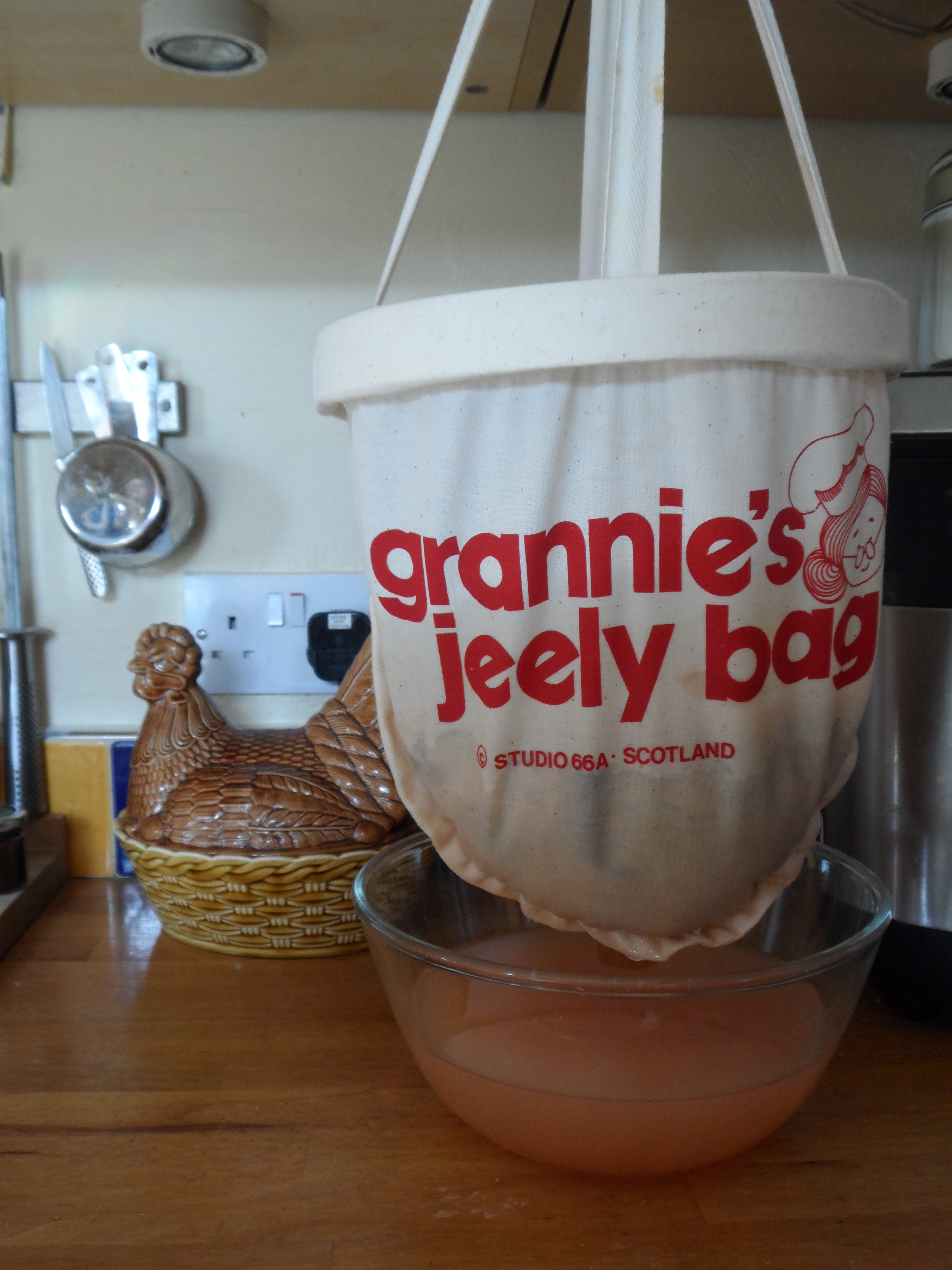
  3. Set up your jeely bag. You do have a jeely bag don’t you? if not, off you go to your nearest jeely bag shop and get one. Or use some cheesecloth and a Heath Robinson contraption using broom handles and the backs of chairs.  My nearest jeely bag shop is a wonderful old fashioned ironmongers in Lanark; it’s the sort of place where the two Ronnie’s might sell four candles.
  4. OK, now you’ve set up your jeely bag, spoon the apple-y mixture into it. Don’t press it down, just spoon it in (over a big bowl) and let it drip. And let it drip some more. And then just leave it for at least 8 hours, but preferably longer. Overnight is good.
Making apple jelly

Making apple jelly

  1. Measure how much apple-y juice you have made and then pour it into another large saucepan. In fact it may be the same large saucepan which you have washed while the bag was drip drip dripping.
  2. For every cup of juice, you need to add almost 8oz granulated sugar. I know this isn’t very scientific, but there you go, it’s the recipe I have and it works for me. And you know what? I suspect you’ll be ok with a teeny wee bit extra sugar, or a wee bit too little.
  3. Put a side plate in the fridge, or freezer now. It’ll become clear later why you’ve done this.
  4. Anyway, add the sugar into the pot, and slowly heat it up, stirring occasionally.
  5. Increase the heat and cook at a full pelt of a boil for about 10 minutes. Watch it ALL THE TIME. Don’t be persuaded to go and see if you can get that blasted printer to work. Your apple jelly will boil over as soon as you have distracted yourself with something else. Trust me, I know this to be a fact.
  6. After 10-ish minutes test for a set – I do this by dripping a small amount of jelly onto that cold plate, and then waiting 20 seconds. Then I push the jelly with my finger and see if it has wrinkles at the edges, or if it is still just liquid-y. You want the wrinkles. If there are no wrinkles keep boiling and test again in a wee minute. Keep boiling and testing till you have wrinkles. Well, not you, your jelly…
  7. Remove the scum from the surface with a holy willie. I’ve been through this before in a previous recipe. A holy willie is what you might call a slotted spoon. Anyway, use an implement to remove the fluffy scum – pop it in a wee bowl and use it on the next piece of toast you make. You’ll thank me for that tip.
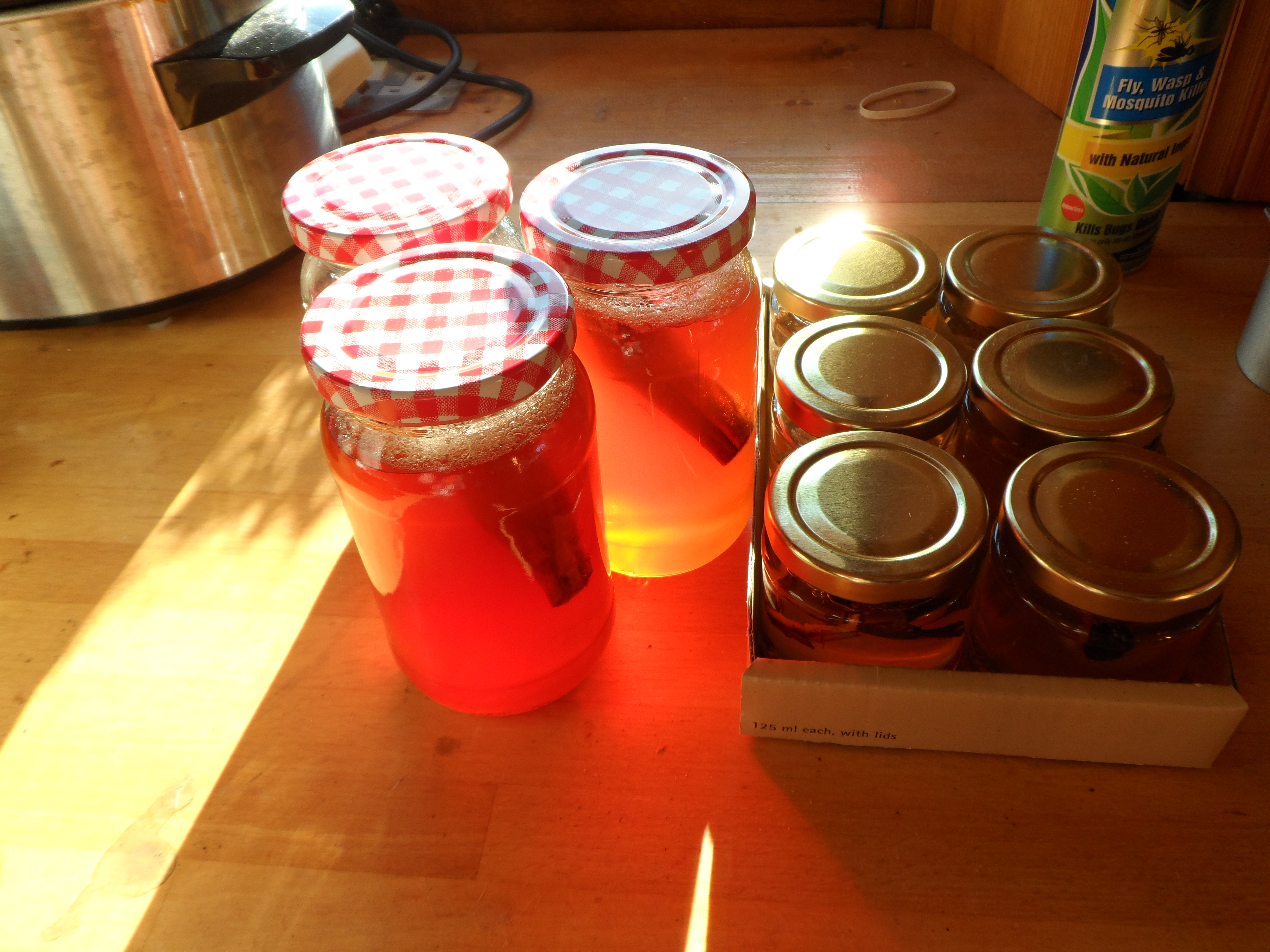
  8. Allow the jelly to cool in the pot for an instant or two and then ladle it into hot sterilised jars. If you’re being fancy, pop a piece of cinnamon stick in each jar before you pour in the hot jelly – it’ll look artisanal, or at least as though you tried.
  9. Seal your jars and label them up

If you make them look pretty they are particularly nice Christmas gifts. You know, for the sort of people who appreciate a jar of something sweet, and think that Christmas is too commercial. Anyone else doesn’t deserve it, not unless you really love them.

Only give as gifts to people you really love

Only give as gifts to people you really love


Thanks to Thane Prince and her ‘Jellies, Jams and Chutneys’ book for this recipe.


The best mayonnaise (and tartare sauce) and it’s easy peasy too

21 Sep

There are far too many cookery programmes on TV these days.

This statement may surprise you, as I’m clearly somewhat obsessed with food and cooking. But cookery has become entertainment, and in my world it’s not the cooking itself that should be entertainment, but the resulting food. Now, don’t get me wrong, I absolutely love the sociability and enjoyment of cooking alongside other people, but that isn’t what most of these programmes are about. There are too many competitive cookery programmes where the point of the programme is to see people mess up, to see a souffle flop; a bread become a brick; a sauce split.

But I do watch cookery programmes, usually ones I can learn from.

And I’ve been surprised this last week to find myself enjoying The Hairy Bikers Best of British. Yesterday afternoon I learned how to make a Pease Pudding, something I’d never really thought of as a real food before, just a line in a song. So sometime in the future I’ll be making Gammon with Pease Pudding and Mustard Sauce – warming food for the winter months.

This weekend I made scampi, with tartare sauce. And ate it in front of the TV, in homage to the 70s. It was divine. The tartare sauce was particularly lush, and I share it here.

Start off by making your own mayonnaise. If you’ve not made mayonnaise before then you might have an idea that it’s incredibly tricky. It’s not. And it doesn’t take long either, so long as you have a hand held beater, or muscles like Pop-Eye and a balloon whisk.

Making mayonnaise al fresco

Mayonnaise

  • 2 free range egg yolks
  • 1 TBsp white wine vinegar
  • 2 tsp Dijon mustard (smooth would be best, but my cupboards dictated I had 1 tsp smooth, 1 crunchy and it was fine)
  • 1/4 tsp caster sugar
  • a pinch of salt
  • 150ml sunflower oil
  • 50ml olive oil
  1. Place the egg yolks, vinegar, mustard, sugar and salt in a bowl and start whisking. I recommend you use an electric beater. Keep whisking till the mixture is smooth
  2. Keep whisking
  3. Add the oil drop by single drop
  4. Keep whisking
  5. The oil will emulsify with the yolkie mixture, and after a wee while you can start adding the oil in a slow trickle
  6. Keep whisking
  7. If you’re feeling brave, start pouring the oil in (still relatively slowly, but steadily)
  8. Keep whisking
  9. Once all the oil is added, you should have some thick, smooth and luscious mayonnaise.
Making mayo
Making mayo

Put half the mayonnaise in a jar in the fridge and use within the next week. It is amazing on a wholemeal roll with smoked ham. Or with warm boiled new potatoes folded into it. Or on a white bread fish finger sandwich,

But you’re going to make tartare sauce with the other half that is still in the bowl.

Making tartare sauce

Tartare Sauce

  • Half quantity of the mayonnaise you have just made
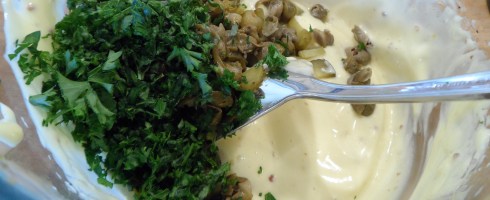
  • 2 TBsp capers, dried on kitchen roll and then roughly chopped
  • 4 cornichons, dried and cut in half lengthwise and then sliced finely
  • 1 large TBsp chopped fresh parsley
  • 1 small TBsp chopped fresh tarragon
  1. Gently stir all the ingredients together
  2. Add freshly ground black pepper to taste

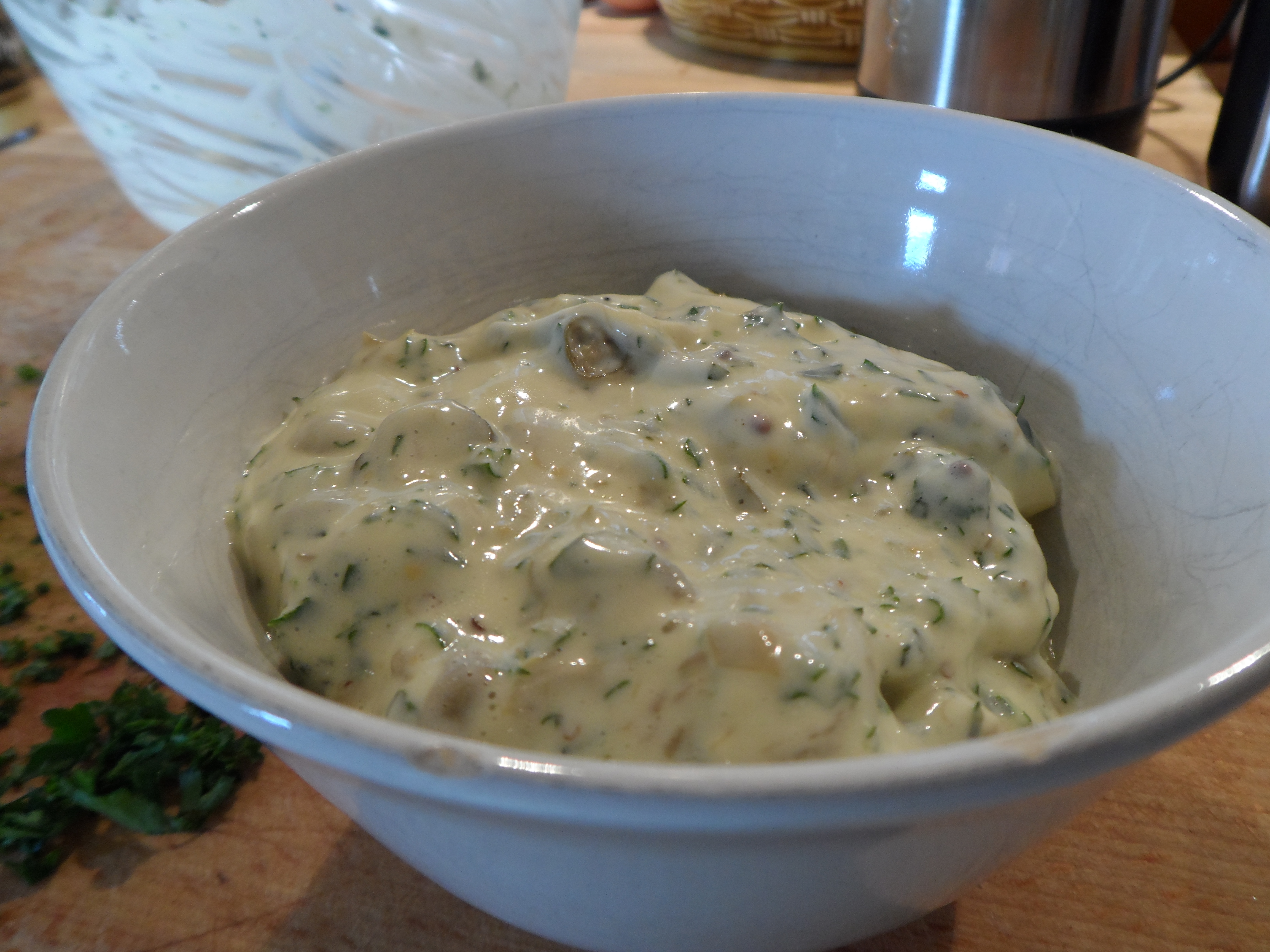
Eat with scampi. Or fish goujons. Or go and buy a fish supper and eat it with your own fresh tartare sauce, and feel proud.

A bowl of perfect tartare saue