Light Christmas cake

19 Nov

I don’t like Christmas cake.  I don’t like mince pies either.  Or any of those heavy dried fruit baked goods.  Well, I’ve not tried them all, so there might be some exceptions, but as a rule I’m not fond of a heavy fruit cake, or any of its close relations.

But a couple of years ago I discovered a distant cousin and fell in love.  It’s more like a stollen, but without the marzipan.  Or the yeast.  Anyway, it’s a light fruit cake, made with apricots, cherries, figs and lots of nuts.  And it keeps for long enough that you can make it in advance of Christmas and it’s still tasty at Hogmanay.

I’d be making it today, but my man has decided to do a deep clean in the kitchen.  And really, I don’t think it’s worth putting our relationship through the strain there would be if I attempted to make Christmas cake while he deep cleaned around me.  It’s going to be tricky enough tonight, to cook supper like a wee secret mouse, except not leaving a trail of pee and poo behind me like a mouse would.  You did know that mice are incontinent didn’t you?  They just pee wherever they go.  But I digress.

I expect you’re wanting to know the recipe for the cake I will be making some day soon in the super clean kitchen?  Here you go.

Originally published in BBC Good Food Magazine December 2008, an Angela Nilsen recipe.

Lovely Christmas Cake

  • 140g / 5oz soft dried apricots, roughly chopped
  • 100ml / 3 1/2 fl oz apricot or regular brandy
  • 140g / 5oz soft dried figs, roughly chopped
  • 250g / 9oz raisins (I’ll use sultanas)
  • 85g / 3oz glace cherries, quartered
  • 50g / 2oz each of almonds, cashews and brazil nuts – roughly chopped
  • finely grated zest of 1 lemon
  • 200g / 8oz plain flour
  • 1/2 tsp baking powder
  • 1 1/2 tsp mixed spice
  • 50g / 2oz ground almonds
  • 200g / 8oz butter, softened
  • 200g /8oz light muscovado sugar
  • 4 eggs

Pre-heat oven to 160C / 140F / GM3

  1. Soak the apricots in the brandy, while you prepare other bits and pieces
  2. Butter and line a deep 20cm round cake tin
  3. Mix together the figs, raisins, cherries, nuts and lemon zest
  4. Combine the flour, baking powder, mixed spice and ground almonds in another bowl
  5. Beat the butter and sugar until creamy in a large bowl (everything else will be added to this one) – prob about 2 mins or so with electric beaters
  6. Add the eggs to the butter-sugar mixture one at a time and beat well after each addition
  7. Gently fold half the flour mixture into the butter mixture.  Then fold the other half, followed by the fruits and nuts, followed by the apricots and brandy.
  8. Spoon the mixture into the tin, smooth the top and make a small dip in the centre.
  9. Bake for 30 mins, then lower the temperature to 150C / GM2 and bake for another 1hour 45 mins.  If it starts to brown too quickly, lay a piece of foil over the top for the last 30 mins – you don’t want it to burn on top.
  10. The cake is done when a skewer stuck all the way in, in the middle of the cake, comes out clean.
  11. Leave the cake in the tin to cool then remove the lining paper and rap well in cling film and foil till ready to decorate.  You could probably skewer it and add more brandy, but I’m not sure it’s entirely necessary and just means that some parents won’t let their kids eat it.

apricots soaking up the brandy goodness

dried fruit and nuts for light Christmas cake
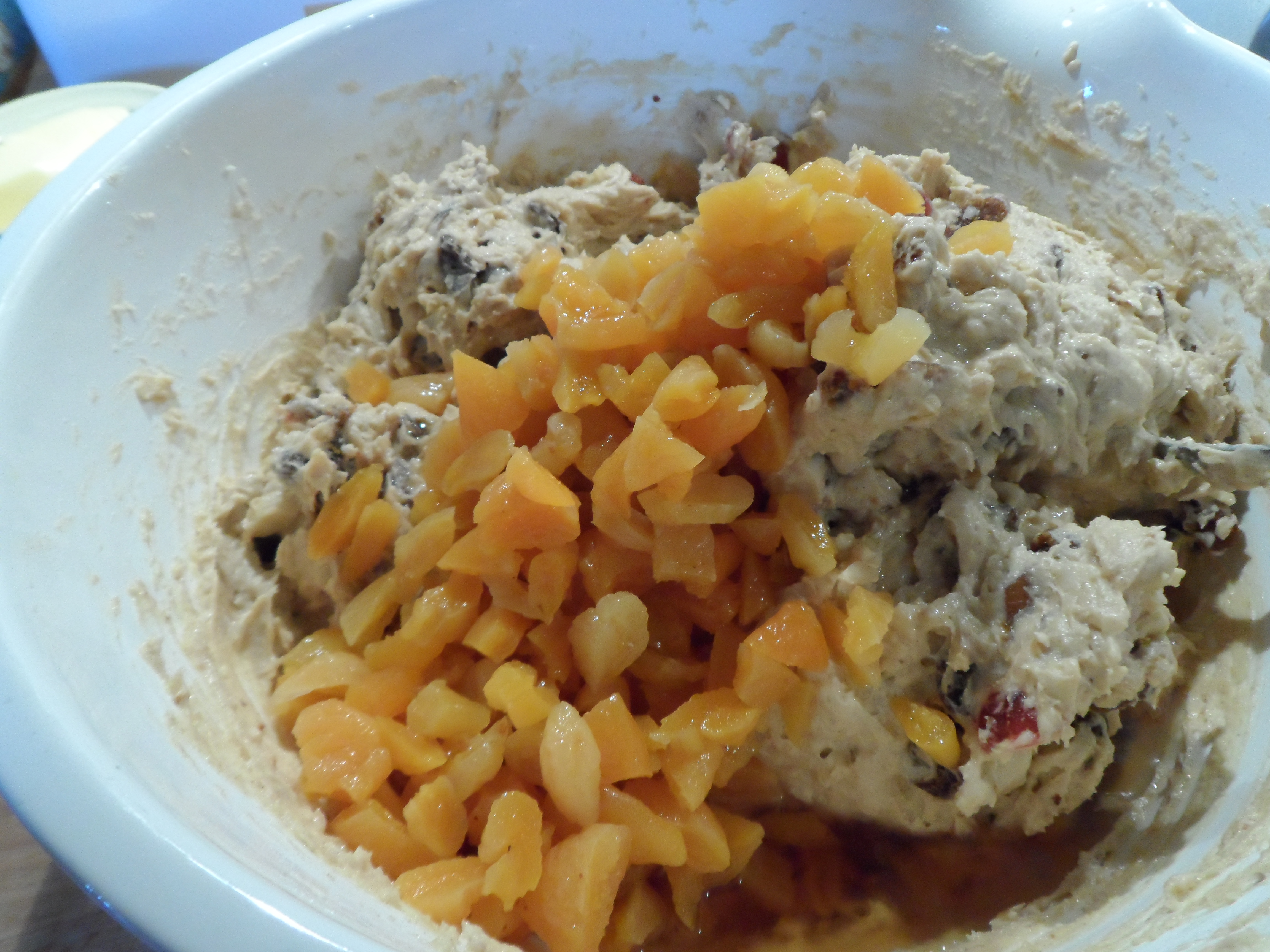
Stir the brandied apricots into the cake mixture
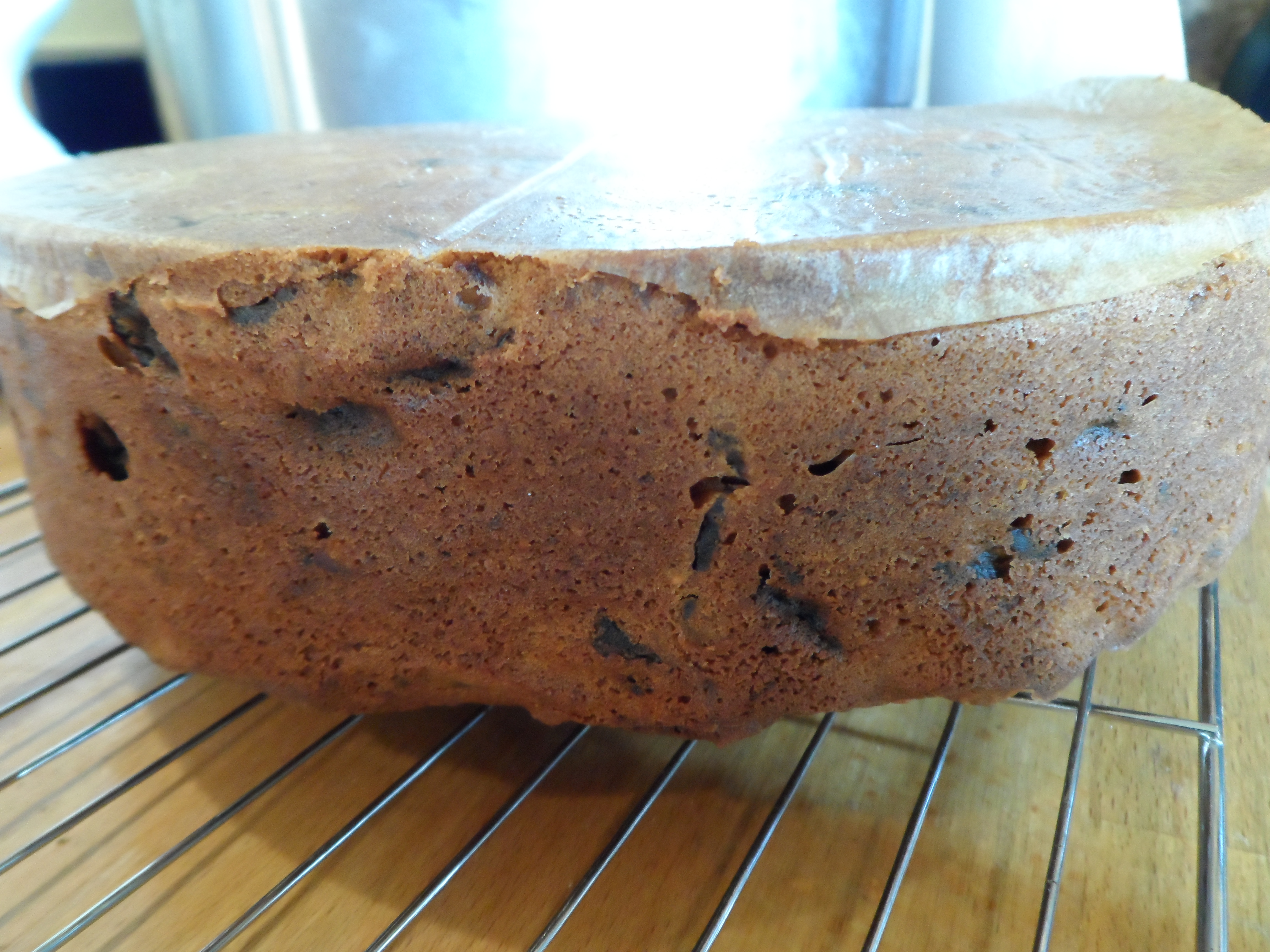
Light Christmas cake cooling on a wire rack

There you have it.  Christmas cake.  All ready for decorating. Or not if you’re my Dad, which I very much suspect you are not.

If you want to see other recipes you’ll find them all listed here.
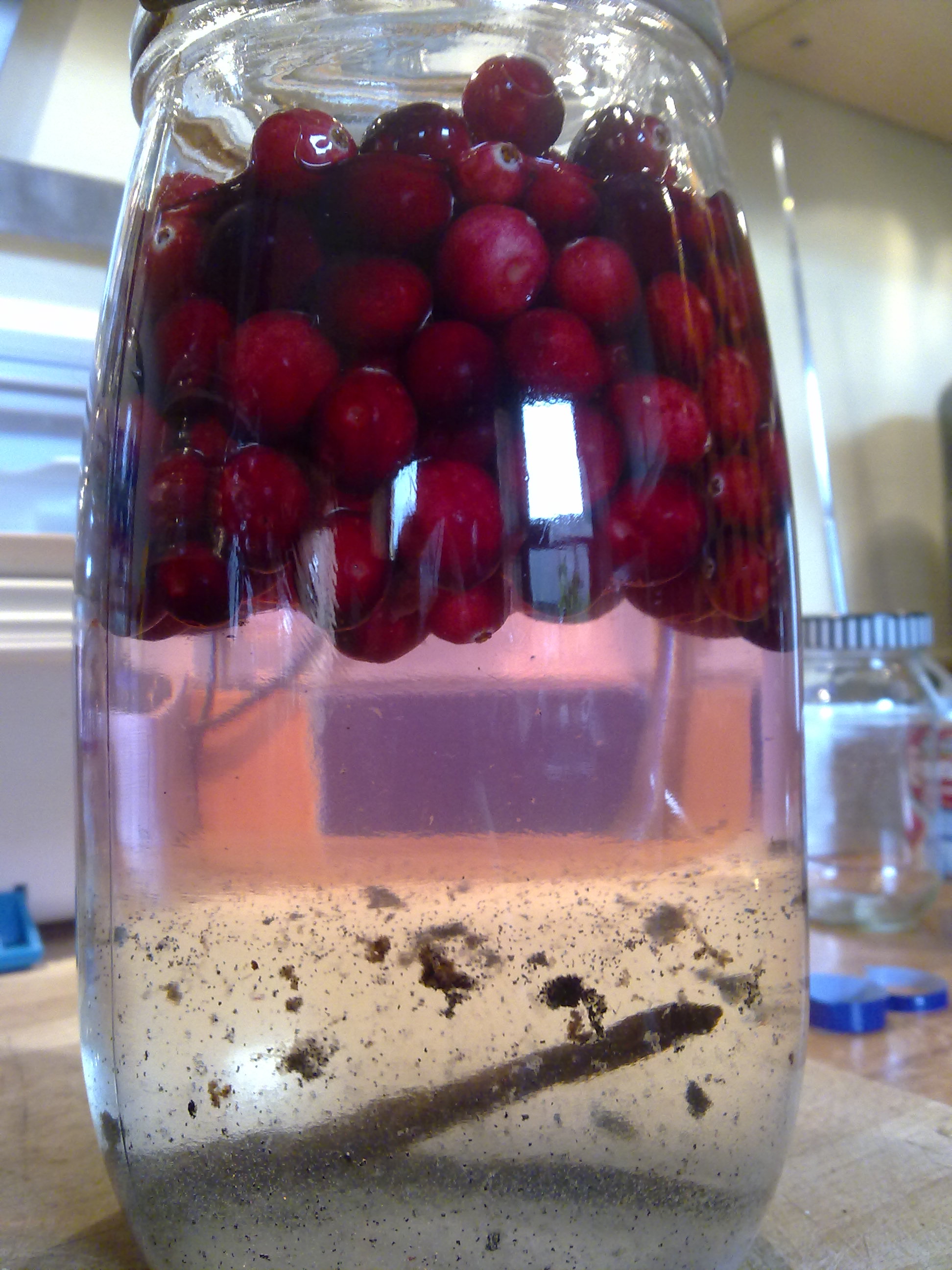
Christmas cheer (in November)

13 Nov

I’ve started.

I didn’t mean to.  I prefer to wait till 20 December for my Christmas preparations, as is traditional in my family.  But there are some things that need time to reach perfection.  And anyway, I enjoy pottering about in the kitchen.

So yesterday I bought some fresh cranberries and a bottle of vodka.  Last time I made cranberry vodka it was far too sweet, but was a perfect late night (after too much wine) shot.  So I’m trying it again.  And plum brandy (if only because I have brandy in the cupboard and our plum harvest in the freezer).

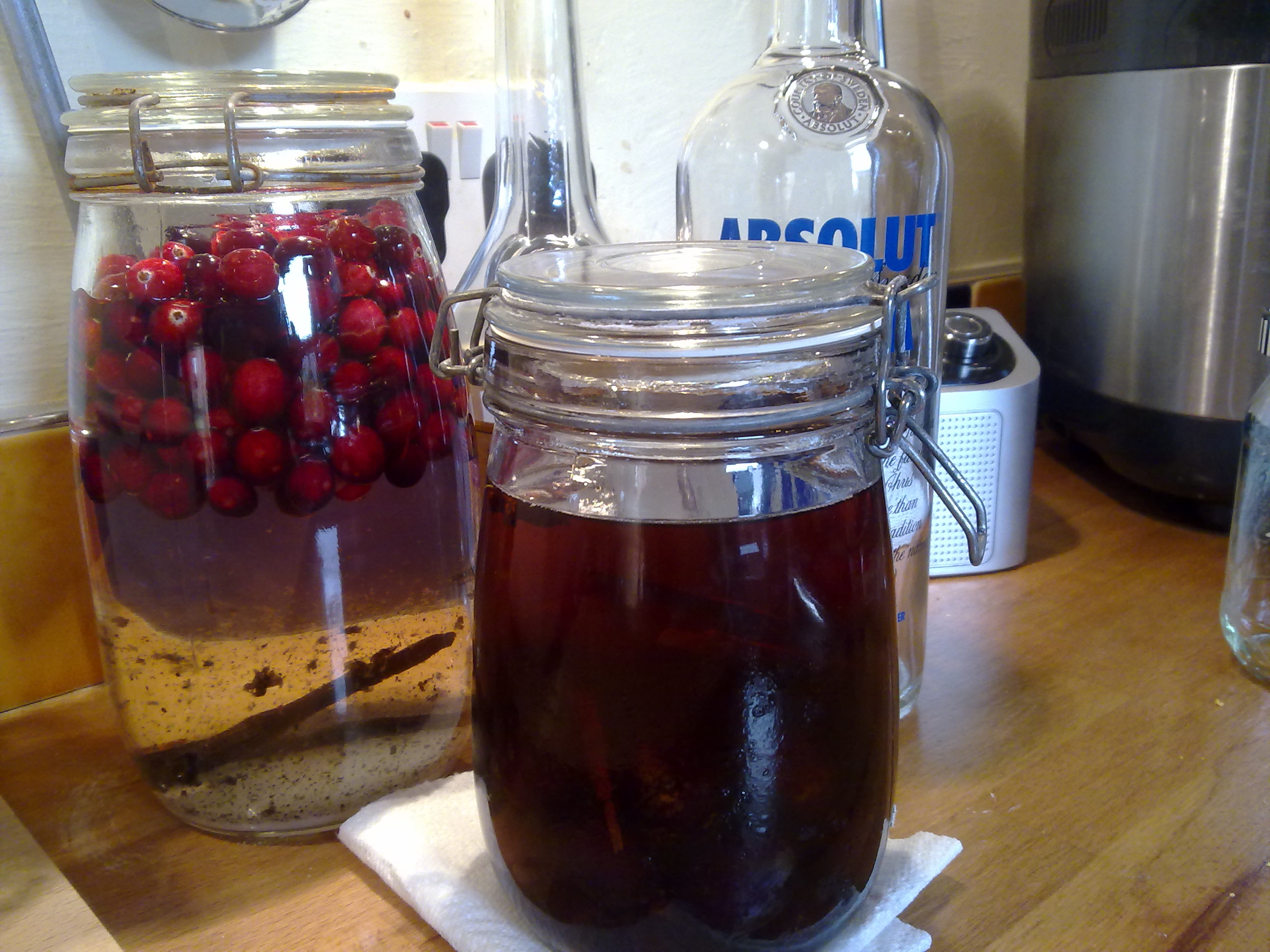
The cranberry vanilla vodka starts with layers of sugary syrup, and lighter alcohol

Cranberry Vanilla Vodka

250g cranberries

1/2 vanilla pod

160g caster sugar

1l vodka

You’ll need a kilner jar, larger than a 1l one.  I think mine is probably 1.5l, but not entirely sure.  Hey, it won’t really matter if your jar is too small, you just won’t be able to fit all the vodka in (so use slightly less fruit and sugar too).

  1. Here’s the slightly laborious bit, although I find it meditatively soothing.  Prick each of the cranberries with a fork, and pop them in the jar.
  2. After you’ve added a cranberry layer, spoon in some of the sugar, then layer with more pricked cranberries and more sugar.  Keep going till you’ve put in all the cranberries and sugar. And I know the pricking seems ridiculous, but really, if you don’t do it the flavour won’t leach out into the vodka so much, and you’ll end up with a disappointing drink, having saved yourself a mere 15 minutes sitting down listening to the radio.
  3. Now using a sharp knife split the vanilla pod lengthwise, and scrape out the seeds into the jar.  Throw the empty pods in too, they still have lots of seeds and flavour left in there.
  4. Pour the vodka in on top of the fruit layers, seal the lid and give it a shoogle.
  5. Leave somewhere out of the way, but easy to hand – so it’s not in your way, but you can give it a wee shoogle every day for the next 3 weeks.
  6. Taste it.  If you’d like it sweeter, then make up some basic sugar syrup, with caster sugar and water, and add it to the jar.  If you like it as is, then bottle it up and put a pretty label on it.
  7. Drink.

Plum brandy

Follow the basic method for Cranberry Vanilla Vodka.  I only had a 1l jar, so I layered plums and soft brown sugar till the jar was about half full.  Then I added a star anise and about 1″ cinnamon stick, followed by some brandy.  We’ll see how it turns out… I suspect I’ll wish I’d put more star anise in it.


Jars of alcoholic tastiness


Next weekend I will probably turn my hand to a Stollen.  I’ve never made one before, but much prefer stollen to heavy fruitcake.  Mind you, I do have a recipe for a Christmas Cake which lasts like a normal cake, but is made of nice light fruit, like apricots instead of all that horrid stuff you usually find in a fruitcake.   

Citrussy meaty goodness

10 Nov

I’d got into a bit of a cooking rut.  Or perhaps a meat rut.  I’d buy mince (for meatballs, chilli or bolognese sauce), and chicken (almost infinite possibilities) and beef (stew of some description, more recently in my new slow cooker).

So I realised that if you keep buying the same things, you’ll keep making similar things.  And I bought some pork loin steaks.  Is that even what they are called?  I’m low carbing (love how I’ve turned that into a verb, I low carb, you low carb, we low carb… we all become diet bores!).  And then I had a quick flick through a recent copy of delicious magazine (why do I so that when I already own so many cook books?) for inspiration.  This was utterly delicious and quite unlike anything I would have normally made.

Pork with orange and thyme

The zest and juice of 1 orange

a few sprigs of fresh thyme

2 pork loin steaks

1TBsp muscovado sugar

  1. Splash some oil into a frying pan over a medium heat
  2. Add the orange zest, and the thyme.  You can throw in the whole sprigs if you want, or just the leaves
  3. Fry for about 3 minutes, till the zest is crispy, then take the zest and thyme out of the pan and set aside
  4. Season the pork with salt and pepper and add to the pan.  Cook for 3 minutes each side, or until browned and cooked through
  5. Remove pork from pan and set aside
  6. Deglaze the pan with the orange juice, and add the sugar.  Simmer until well reduced.
  7. Add everything back into the pan again and warm through.
  8. Serve with savoy cabbage.
OK, you could serve it with lots of other things, but I’m still low carbing so it was just perfect with a big mound of bright green savoy cabbage.

It sounds more complicated than it is with all the taking out of the pan and setting aside – just make sure you have a wooden chopping board to rest the meat on (or a warm plate) and you’ll be fine.


Melting moments

30 Oct

So, this is a recipe I used to make years ago, when I was a teenager.  The original recipe is from Rosemary Wadey’s Cakes and Cake Decorating which I think I bought with either school prize money, or a Christmas book token when I was about 14 years old.  It has some of my favourite biscuit recipes: Grantham Gingers, Oat Crisps, Viennese Biscuits and the easiest of all: 1-2-3 biscuits.  But perhaps my favourite was Melting Moments – they are easy to make, look as though you might have bought them and taste scrumptiously delicious.

And they can be adapted. The basic recipe is for vanilla biscuits, rolled in scrunchy cornflakes before they are cooked, and with a nub of glace cherry on top.  When I made them recently I realised we only had chocolate weetabix in the cupboard, no plain cornflakes.  So, I made chocolate melting moments, rolled in scrunchy chocolate weetabix, still with a nub of glace cherry on top.

Chocolate cookies

Anyway, here we go:

Melting Moments

6oz butter (or half and half, butter and lard – oh yes, this recipe is so old that it uses lard.  But in reality, lard can create a shorter texture for biscuits). Soften the butter before you start cooking (so you might want to leave it out in the kitchen for a while before you start)

5oz caster sugar

1 egg, beaten

10oz self raising flour, sifted

1 tsp vanilla essence

about 2oz cornflakes, crushed (use a small plastic bag and scrunch them)

8 glace cherries, quartered

Pre-heat oven to 180C / 350F / GM4. Grease 2 baking sheets

  1. Beat the butter until soft, then add the sugar and cream until light and fluffy.  This is the most important step in this recipe – if the butter and sugar isn’t creamed properly the mixture won’t be light enough
  2. Beat in the egg and vanilla essence
  3. Work in the flour to give a fairly stiff dough
  4. Take dessertspoonfuls of mixture and roll them into balls
  5. Roll each ball in crushed cornflakes and place fairly well apart on the baking sheet
  6. Flatten the balls of mixture slightly and press a piece of cherry into the centre of each ball
  7. Bake for 15 – 20 mins or till golden brown.
  8. Cool on a wire rack and store in an airtight container.
Alternate versions:
Replace 1-2 oz of flour with 1-2oz of cocoa powder and about 1/2 tsp baking powder.
You can also replace some of the flour with custard powder to give a smoother and creamier biscuit.  Again, just swap some of the flour for custard powder, and add a wee bit of baking powder.
I think they would be nice with a wee bit of chopped ginger (you know, the stuff out of the jar) in them.  But then I love gingery things.  You would probably want to replace the glace cherry with a nubbin of ginger too.  Yum.

The most delicious blackcurrant recipe ever

9 Oct

Earlier this year we had a glut of blackcurrants.  I picked them on a Sunday in the sunshine, cutting whole branches from the bushes and then sitting in the sun on the terrace picking off the juicy black fruit.  Over 9lbs of fruit, all topped and tailed (not that they needed any topping, or was it tailing) and stored in plastic tubs in the freezer till I had more time to turn them into loveliness.

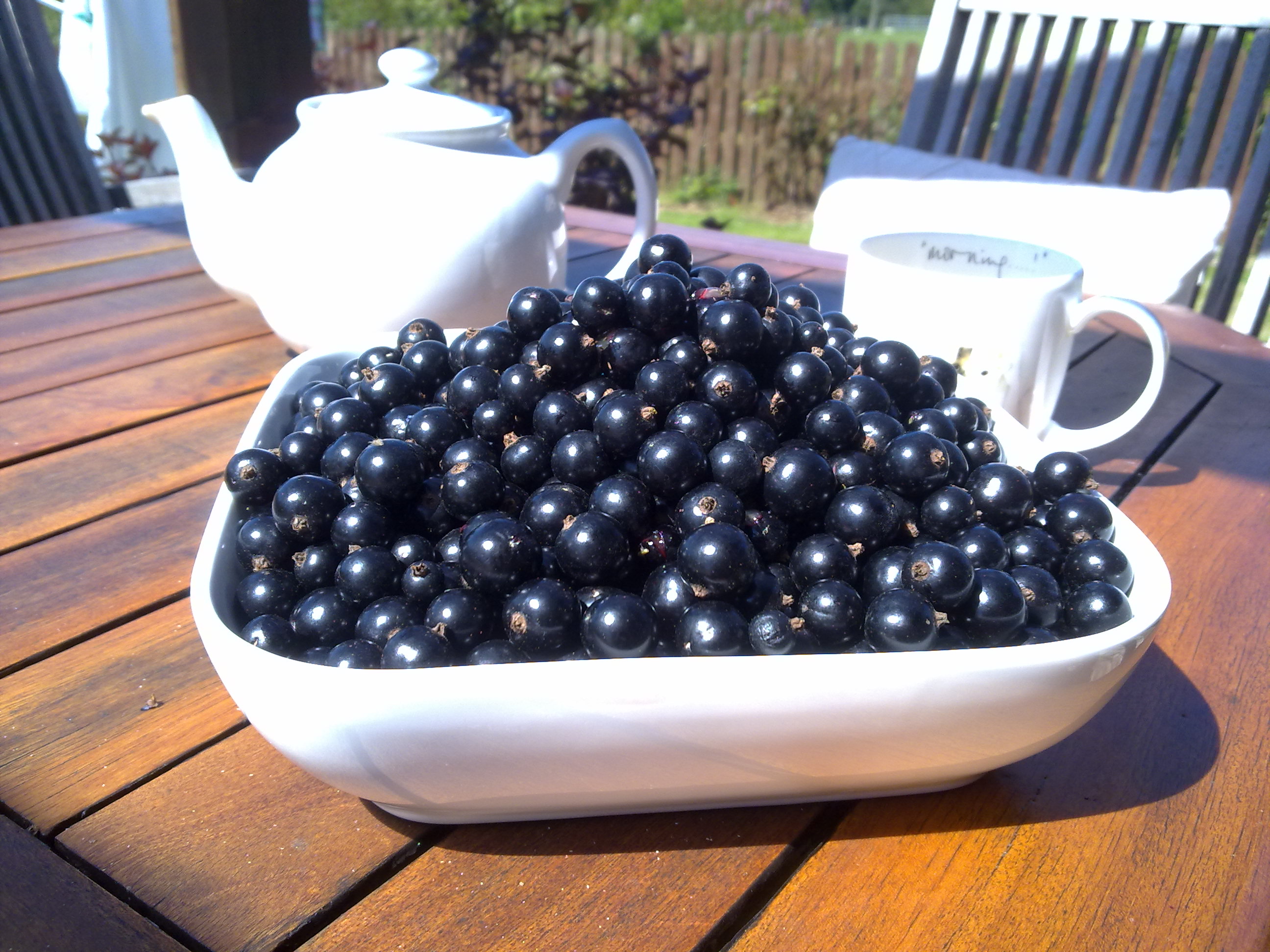
Blackcurrant harvest

This weekend was the time.  And the loveliness was Blackcurrant Ripple Icecream.  Why have I never made this before?  It’s amazing and oh so simple.  Thanks to Xanthe Clay and the BBC Good Food website for this deliciousness.  I’ve slightly altered the recipe, but literally only slightly.  You can find the original and a gorgeous picture here http://www.bbcgoodfood.com/recipes/11802/blackcurrant-ripple-ice-cream

Blackcurrant ripple icecream

200g blackcurrants (if frozen, leave them out for a while to defrost)

50ml apple juice

100g golden caster sugar

600ml double cream

large tin condensed milk

2 tsp vanilla extract

  1. Put the currants and the apple juice in a large heavy-bottomed pan and gently heat
  2. Simmer for about 5 minutes and then add the sugar
  3. Heat gently again and bring back to a simmer, stirring all the while to ensure the sugar all dissolves
  4. Simmer for a further 4-5 minutes, till it gets beautifully syrupy.  Don’t be too precious about the timings here, but you don’t want to reduce this right down, just make a lovely rich sauce for the ripple
  5. Now, take it off the heat and let it cool for a while.  A long while – it needs to be properly cool.
  6. Rub the sauce through a sieve to get rid of all the pips
  7. Now, leave that to one side while you make the icecream
  8. Pour the cream into a big bowl and whisk up to soft peaks
  9. Add the condensed milk and vanilla and whisk again to soft peaks
  10. That’s pretty much it.
  11. Find a freezer proof tub to put the ice cream in.  Pour the creamy ice cream in, then the sauce… swirl it a wee bit with a palette knife, or big spoon.  Try to get into the corners, but don’t mix too much – you’re looking for a rippled, or marbled, effect not a homogeneous mixture.
  12. Freeze.. for at least a couple of hours, but preferably longer.  It will probably need to come out of the freezer for a while before you serve it as it’s quite a solid ice cream, so take it out when you start your main course.

Enjoy.  Delicious with langues du chat biscuits, or similar.  Oh, did I mention I also made the most scrumptious langues du chat this weekend? The Great British Bake Off has been inspiring me!

As an alternative, make up the ice cream mixture and fold in either shop bought or homemade lemon curd.  I don’t know why you’d buy it, it’s simple to make and so much tastier when it’s not packed full of preservatives (and when was it ever going to last 6 months in our house anyway?).  But as I was saying, this ice cream is just delicious as a lemon ripple instead of blackcurrant ripple.  Try it.  Next I’m thinking of a butterscotch ripple, but suspect it will be too sweet – you need the sharpness of the lemons or blackcurrants to cut through the soft sweetness of the condensed milk in the ice cream.

Or, if you want to make Blackcurrant Cordial, or an alcoholic Blackcurrant Liqueur, then take a look at how I do it here.


Broccoli and stilton soup

1 Oct

So, when Tesco builds a new store, they do all manner of strange discounts.  We have a new Tesco in the valley and today there were bags and bags of broccoli for only 10p each, all marked ‘TEST’, but all looking like fresh and scrummy broccoli.

They also had enormous whole salmon reduced from £35 to £10. I think they were about 8lb weight. But since G’s sister had already bought a whole salmon earlier in the week and stuffed our freezer full of salmon steaks I resisted that particular temptation.

And grabbed the bags of broccoli.  And a wedge of stilton.  You see where I’m heading don’t you?

Broccoli and stilton soup

1 large onion, finely chopped

1 medium large potato, chopped into small chunks

about 1.5l veg stock

1 large head of broccoli, cut into small-ish chunks

about 100g stilton in chunks

  1. Sweat the onion in a heavy based saucepan with a wee bit of oil or butter.
  2. Add the potato and sweat for a few minutes.
  3. Add the hot stock (or boiling water from the kettle and a stock cube). Cook for about 10 minutes, till the potato is cooked.
  4. Add the broccoli and cook for a further 4 minutes or until the broccoli is cooked.
  5. Add the stilton and smoosh it all up with the electric zizzer.
Perfect for a quick light lunch.  And I’ve heard a rumour that it is good to freeze.
Oh hey… if you have a lovely soup recipe and want some recognition… go here: http://www.newcoventgardensoup.com/competition

Chicken liver pate

25 Sep

OK.  So it’s a cooking weekend.  I could add the beef stew (a sort of boeuf bourguignon, but only because I added red wine) but I think I’ll leave it for another day.

Today my nephew made pizza for lunch, and very tasty it was too.  I made a salad or two to accompany it, and to be honest hardly any salad got eaten, but that’s the way of salad when there’s pizza about.  Even pear, blue cheese and toasted walnut salad with a honey dressing.  Ah well.

But after lunch I made chicken liver pate.  It’s so easy. Why don’t I make this all the time?

I looked up a number of recipes, and then went my own way, incorporating what I’d learnt, but not being a slave to the recipe.

The starting point was that I had 270g of chicken livers.  I popped them in a small bowl (actually a souffle dish) and covered them in milk, and then abandoned them in the fridge for a couple of hours.

Then I finely chopped a shallot and gently gently cooked it in its own body weight of butter.  Once it was deliciously soft, I added a chopped clove of garlic.  You could of course have squidged the garlic through a garlic press, but I think life is too short for cleaning garlic presses.  Anyway, the last one I had I squidged the garlic into a dish and ended up having to fish out lots of wee bits of metal from the supper.  The holey bit of the press had sheered out with the pressure of the garlic. Not nice.

OK, soften the garlic in the buttery goodness for a wee while.  Add thyme or sage or bay if you have any. Or marjoram.  Marjoram was all I could find, so that is what we’ve got.  Thyme would have been much much nicer.

Way before you added the garlic, while you were listening to the gentle cooking of the shallot, you should take the chicken livers out of the milk and popped them on some kitchen paper on a plate.  Soak up the milk a bit and then pick over the livers and remove any green bits, or any stringy fatty bits (you know those bits that join two lovely livery bits together). Don’t be over fastidious about the stringy bits – but be as pernickety as you like about the green bits.  Eeek.

Once the garlic has been doing its thing with the butter and shallots for a while, add the chicken livers in.  Turn up the heat a bit, but not too much – you don’t want anything to burn, just to cook.

The livers will only need 4-5 minutes to cook – they should be soft brown on the outside, but still pink on the inside.

Now, plop it all into a liquidiser.  And liquidise.

Once it is all combined, add more butter.  I’d left the butter out on the side all morning so it was deliciously soft, but it will melt quickly anyway in the hot pate.  For 270g of livers, you should add about 140g of butter in total (including what you used to cook the shallots and garlic).  I didn’t weigh anything, but I think I added about that much, judging by how much wasn’t left in the packet!

Now, put the pate into a dish.

Melt enough butter to pour over the top of the pate to make a seal.  Once the butter is melted, spoon it over the top of the pate.  Only use the oily butter which is on top, and throw the liquid white whey away.

A true professional would have added a herb to the melted butter and let it steep for a while to add extra flavour to the finished pate. I didn’t bother.  And I’ll bet it’s delicious anyway.  You can also add madeira or brandy as you cook the chicken livers, but I don’t think it needs it.  Unless of course you are looking for ways to use up those bottle ends of brandy or madeira.

Enjoy with sourdough bread or toasted white, if you’re eating carbs.  If not, have it with a big salad of spinach with sweet cherry tomatoes.  Even an onion relish/marmalade.

Now, I’ve discovered there are lots of apples in the garden, needing to be made into something.  I think it’s time for apple chutney.


Sophisticated chocolate brownies

25 Sep

Brownies seem to be endlessly adaptable.  I’ve made them with ginger, with nuts, with more and more and more chocolate. I think I must try them with mint.  And possibly orange, although I’m never quite sure about chocolate and orange, and thoroughly disapprove of orange anywhere near milk chocolate.

But this weekend it’s all about the sophisticated flavour combo of cardamom and chocolate.  I have to credit both The Times and West London’s favourite provider of baked goods: Cocomaya. So, thank you.  And I hope you don’t mind me re-producing your recipe here.

I’m looking after my nephews this weekend, so am cooking in a less familiar kitchen, although having a Rayburn to bake in is a delight and reminds me of happy happy childhood weekends, baking scrumptious goodies for the family.

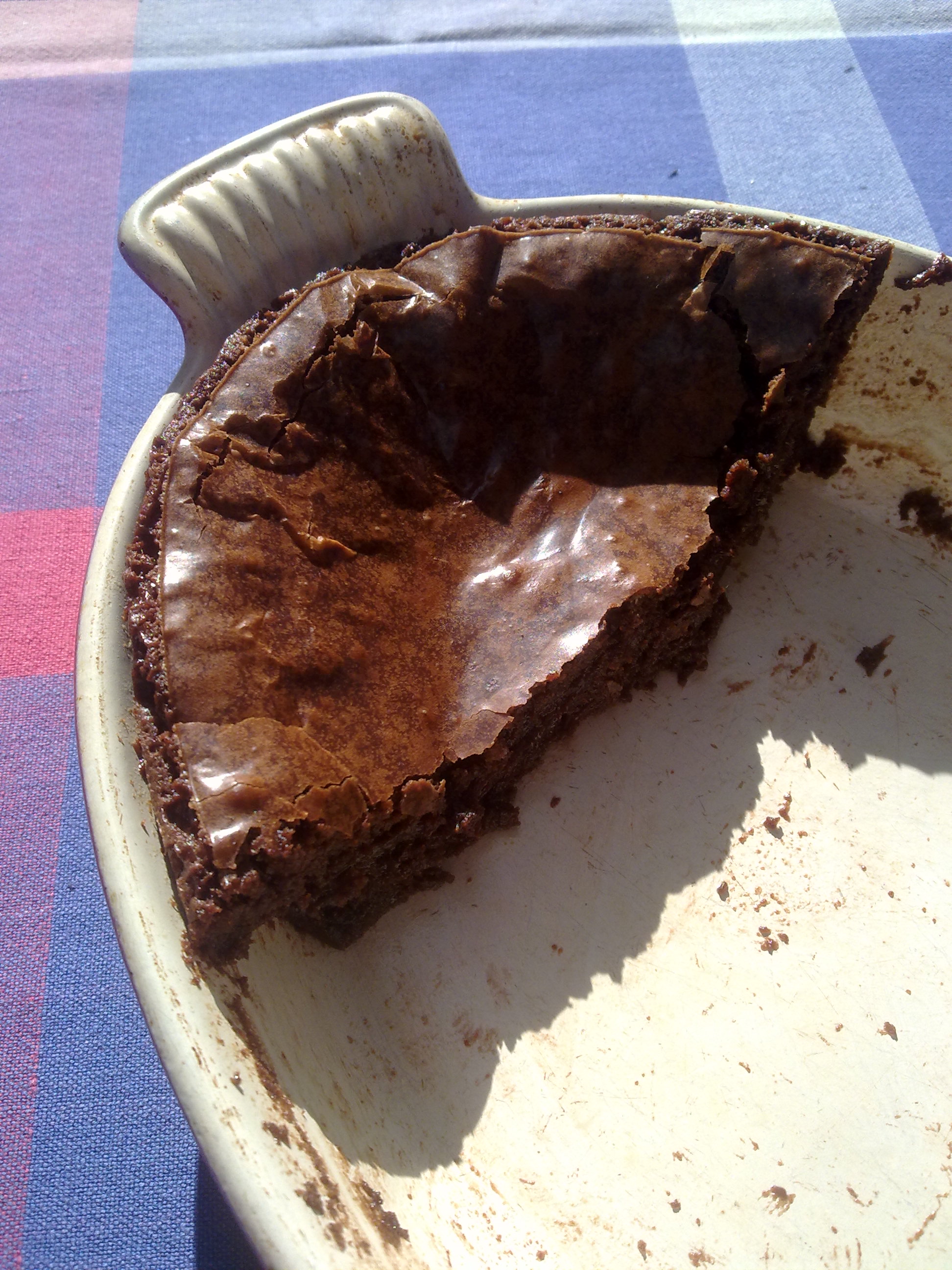
Posh chocolate brownies in a Le Creuset dish

Cardamom chocolate brownies

250g unsalted butter (I used slightly salted as that was what was in the fridge)

15 green cardamom pods

100g plain flour

1/4 tsp baking powder

350g dark chocolate (at each 70% cocoa solids)

250g muscovado sugar

50g caster sugar (I used a combination of soft dark brown and soft light brown sugar)

4 large eggs

1/2 tsp salt

15 x 20cm cake tin… I couldn’t find the right size, so ended up using a le creuset oval lasagne style dish, approximately the right size

Oven 130C, GM2.  The Rayburn was on medium, which is probably slightly higher than recommended

  1. Grease the baking tin
  2. Slightly bash the cardamom pods and extract the black seeds, throw away the green dry husks
  3. Put the butter and the cardamom seeds into a small pan and melt.  Set aside for a few hours.  If you have an Aga or a Rayburn  then leave it on the side where it can remain liquid.
  4. Sift the flour and baking powder into a small bowl
  5. Place the chocolate in a bowl and strain the butter onto it. Place over a pan of simmering water to melt
  6. In a large bowl mix the sugars together and squish out any lumps.  Add the eggs and mix.  Don’t beat, you don’t need to add air to this mixture (although I was reading a Hugh Fearnley Whatsisname recipe last night which says you beat for 4-5 minutes at this stage to incorporate lots of air. I didn’t and it worked out REALLY well).
  7. Add the chocolate-butter mixture and stir through
  8. Fold in the flour, followed by the salt
  9. Pour the batter into the prepared tin – spread into the corners if you need to.
  10. Bake for about 45 minutes.  The recipe states only 20 minutes, and in the end I baked it for just over an hour and it still has the lovely squidgy gooey-ness.
  11. Leave to cool and then cut into pieces.  I note that Cocomaya decorate theirs with gold leaf.  Feel free to do the same if you have any spare gold leaf hanging about in your cupboards.

Lemon kisses

11 Sep

It’s Autumn. It has to be – it’s Sunday and we lit the fire mid morning and just hung around and read the papers.

The Sunday Times is our paper of choice; well it’s his paper of choice and I really don’t mind.  I love AA Gill‘s writing and generally read most of the main paper, the news review section and one or two of the features in the magazine.

So far today all I’ve managed is the main paper, until I got too cross about the article on obesity – GPs are offering people gastric band surgery, and the mayor of somewhere or other says that poor people can only afford junk food.  A gastric band should not and must not be seen as an easy solution to obesity – sensible eating and taking more exercise have to come first.  And anyone who believes that junk food is cheaper than fresh food should actually look at what they are eating, and what they could eat if they cooked from scratch.  Fresh veg is not an expensive option, and I don’t believe that junk food is cheaper than a pot of homemade soup.

I’ve been overweight all my life, despite eating relatively healthily (if you believe that relatively low fat, fresh food is healthy).  I live a pretty sedentary life and haven’t exercised for years, literally years.  I’m not proud of this.

I have never thought that a gastric band could be the answer, but have tried weight watchers and other calorie based diets in the past.  Nothing has felt easy for me and the weight has always crept back on.  It’s hard to keep it off when cooking and baking are such enjoyable and key activities in my life.

In July this year I saw a nutritionist.  She asked me thousands of questions, and ‘prescribed’ a low carb diet for me.  No carbs for breakfast, and low carbs for the rest of the day – concentrate on proteins and green veg; avoid white processed carbs, and avoid fruit juice.  In fact avoid most fruit, especially bananas.  I’ve not had a glass of fruit juice or a banana since.  And so far I’ve lost 11lbs and feel healthier than I have in years.  And I’ve never felt hungry, or struggled to know what to eat.

Now, I’m not suggesting that all obese people try this – but it works for me.  I have a metabolism that copes well with this regime.  From day one I haven’t craved a carb, and the best thing about this eating regime is that there are just whole aisles in the supermarket that I just walk past.  Why walk down the bread aisle if I’m not going to eat processed carbs?  In fact, apart from household stuff, I pretty much just go to the meat/fish/dairy and veg aisles and leave all the others.  I’m discovering some interesting new flavour combinations, and now know that I don’t need pasta or rice or potatoes or bread to bulk out a meal for me to feel satisfied.

One disadvantage is that it is not a cheap way of eating as protein rich meals tend to be more expensive than carb rich meals.  Swapping my porridge for scrambled eggs for breakfast may help my weight-loss, but does not help the bank balance.

However, I’m buying more sensibly and not throwing out as much food as I used to, so perhaps it’s balancing out.

Anyway, you might be wondering why this is called lemon kisses if it’s all just about obesity.  I warn you, lemon kisses are not going to help in any diet, whether you are low fat, low carb, low calorie.  It’s got them all.  But oh, they are so light and buttery.  And lemony.

Autumn Sundays aren’t just for getting cross at the papers. They also need to involve lots of good kitchen time – yesterday I made some sweet gherkin pickle (so easy and so delicious) and today is all about the baking.  And knitting.  More on the knitting soon.

But back to the lemon kisses.

I first made them back at the beginning of the year, and then promptly forgot where I’d put the recipe.  So, I googled today, and here they are, courtesy of the BBC Good Food website.  A batch is in the oven right now.

Lemon kisses

200g butter, at room temperature (or warmer if your kitchen is as cold as mine)

140g caster sugar

1 egg yolk

1 tsp vanilla extract

zest of 1 lemon

280g plain flour

And for the filling and icing:

1/2 jar lemon curd (preferably home made – go on, it really is deliciously simple to make and who hasn’t got 30 minutes to make a jar of lemony loveliness?)

zest of 1 lemon

juice of 1 lemon

140g icing sugar

Oven 180C, GM6

  1. Mix the butter, sugar, vanilla extract, egg yolk and lemon zest with a wooden spoon in a large bowl
  2. Add the flour and mix together – you may struggle to get it all to bind with the spoon, so tip it out and lightly knead it together with your hands
  3. Roll out (I do it in two batches) on a lightly floured surface and cut into cute little biscuit shapes
  4. Place on baking trays and pop in the fridge for about 30 mins
  5. Bake for 8-12 minutes till golden. Cool on a wire rack
  6. When cool, spread half the biscuits with a little lemon curd, and sandwich each with a second biscuit
  7. Mix the lemon juice and icing sugar, and drizzle over the biscuits; sprinkle with lemon zest.  Leave to set on a wire rack
  8. Eat. In moderation.
One of my favourite easy puddings is a pretendie lemon ripple ice cream, made with a couple of scoops of nice vanilla ice cream (not too sweet a brand) and some lemon curd swirled through it as it’s served.  Serve with lemon kisses.  I guess you could go mad and do a lemony knickerbocker glory with ice cream, fresh cream, lemon curd and lemon kisses. Perhaps even some crumbled lemon kisses over the top of the glory as decoration? Over to you – just remember that eating a knickerbocker glory every day is probably not the best way to get a portion of your five a day.  You heard it here first.

The tomato glut

5 Sep

OK, so it’s a self-inflicted tomato glut, as I bought a whole big box of tomatoes at the farmers’ market yesterday.  Is it a farmer’s market or farmers’ market?  There seemed to be many farmers there yesterday so I’m settling for farmers’ market on this occasion.

Anyway, I was seduced firstly by some very nice bacon from the lovely Sunnyside Farm near Sanquhar (where I hope to butcher a pig later this year) and then some fresh beetroot, which I adore, and eat in vast quantities, making up for the many, many years when I refused to eat it at all, on account of its unacceptable vinegariness.  Who knew it didn’t need to come in a jar full of vinegar?

Then, just when I thought I was safe, I spied the boxes of tomatoes, with a lovely handwritten sign: Tomatoes different sizes and shapes. £3 a box.  How could I resist?

The first recipe also fortuitously made use of my birthday purchase of a large second-hand Le Creuset lasagne-style dish (bought at Garrion Bridge for only £10).  Roasted tomato passata.  Or sauce to you and me.  It’s adapted from a Hugh Fearnley Whatsinstore book.  The preserves one.  Thanks Hugh.  And Pam Corbin who actually does the preserves, and writes the recipes.  So far all the recipes I’ve tried are lush, so go buy the book, and get the original recipe, along with all her good advice on sterilising jars and all that jazz.

Roasted tomato sauce

about 1kg tomatoes

2-3 shallots, peeled and sliced thinly

2-3 garlic cloves, also peeled and sliced thinly

A few sprigs of a mediterranean herb like rosemary, thyme, basil or oregano, alternatively add a teaspoon of crushed fennel seeds.  Add some sliced fresh chillies if you want a kick, or dried chillies if you haven’t grown/bought any fresh ones!

1/2 tsp salt

a good few grinds of black pepper

1/2 tsp sugar

a serious glug or two of olive oil

Preheat your oven to GM 4, or 180C

  1. Cut your tomatoes in half, and place them cut side up in the dish.  You may end up with a couple of layers, but that’s ok.
  2. Scatter all the other ingredients over the top
  3. Roast for about an hour or so, about until your nose is telling you that there is something seriously delicious in the oven
  4. Use a large spoon to muddle the tomatoes around a bit in the pan, allowing the juicy tomatoes to dissolve some of the lovely caramelised burnty bits in the corners. Or don’t if you’d prefer not to have the richer colour and flavour in your final sauce
  5. Cool for a wee bit and then liquidise.  I put it in a bowl and use the hand-held zizzer, but you could use a proper liquidiser.  Or Pam recommends sieving it, or putting it through a mouli or a passata machine.  Who owns a passata machine?  Hands up.  Get over yourself.  Just zizz it with a zizzer and call it rustic tomato sauce.
  6. Now, I don’t bother with the whole jar thing at this stage, which seems to add a layer of complication I can’t be bothered with when I only have a weekend to play with.  (You have to put it in sterilised jars and sort of seal them, and then put them in a large saucepan of water and simmer the whole lot for a while).
  7. Pop in a labelled freezer bag, and pop the freezer bag in a suitable plastic container. Put it all in the freezer once it’s cooled enough not to defrost your freezer.

And that’s it.

I used the first batch straight away with homemade meatballs and it was absolutely delicious.

My second recipe was Tomato and Fennel Relish, but you’ll have to wait for that because I’m back in Edinburgh now and the recipe book is in the Valley.