Tag Archives: jubilee baking

Bacon maple brownies

11 Dec

Thank you Nigella.  They’re in the oven, so I don’t know yet if they are to die for, or a waste of some perfectly good ingredients.  The constituent parts were scrummy (well, I had to lick the spoon after scraping the brownie batter into the tin, and the baconny-syrupy scraps on the plate were just asking to be licked up).

But really?  Bacon in chocolate brownies?  I totally see where you came from with this – bacon and maple syrup pancakes are divine.  And as a child I remember the treat that was bacon with fried bread and honey. Now, whatever happened to fried bread?  Did the health Nazis get rid of it for good? Possibly not the worst decision ever made, but still divine in my childhood memory.

Anyway, Nigella sent me a recipe for Bacon Brownies.  Well, she didn’t just send it to me, it was sent out to anyone who subscribed to whatever style thingy she’s guest editing this week.  And now I’m wondering if it was all just a big hoax, to see what muppets would actually make it.  Well, here I am, prize muppet! I give you Bacon Maple Brownies, inspired by Nigella, but not exactly the same.

Bacon maple brownies

Preheat oven to 190C / 375F / GM5

(OK, now I see why my finished brownies seem even gooier than they should be, I had the oven not quite hot enough).

Grease and line a 25cm square brownie tin.  Or Nigella does it in a throw away tin, of course she does.  Her hands aren’t made for washing up.  And it’s so much easier to take a gift of brownies when you pop in to your neighbours if they are in a throw away dish!

100g thin rashers of streaky bacon, snipped or chopped into teeny weeny pieces

2tsp maple syrup (or golden syrup)

150g unsalted butter

250g soft light brown sugar

75g cocoa powder

150g plain flour

1 tsp bicarbonate of soda

4 large eggs, beaten

150g chopped chocolate (dark, or milk)

  1. Heat a heavy frying pan and then add the bacon bits, and fry till they are just going crispy
  2. Add the syrup, and mix quickly, then pour the whole bacony syrupy mixture onto a plate to cool
  3. In a large heavy pan melt the butter over a low heat.  This is the pan the whole batter will be made, so make it big enough
  4. Once the butter is melted, remove from the heat and stir in the sugar with a wooden spoon.  Bash out the sugary lumps (unless you anticipated this and sifted it in advance).
  5. While the butter was melting you should have put the flour, cocoa and bicarb into a bowl and mixed it.  And cracked the eggs into a bowl and beaten them.
  6. Once the sugar and butter are mixed, add the flour mixture and stir it in
  7. Add the beaten eggs, and stir all together
  8. Throw in the chopped chocolate, and then use your finger to nudge all the bacon off the plate into the chocolate batter. Lick your fingers.  And wonder if this was all a hoax and you should have just made ordinary brownies, and had maple syrupy bacon bits as a separate snack.
  9. Mix all together
  10. Pour the batter into the prepared tin and bake for 25 mins or so.  It will still be slightly wobbly, so you have ultimate gooeyness in your brownies.  But if you cook it at the right temperature it shouldn’t be too gooey.
  11. Leave to cool in the tin, then remove and cut into pieces.  Not too small, but not too big pieces.  You know, a couple of decent mouthfuls.

Don’t tell anyone what is in them

Mine are out of the oven now and I’ve decided it’s not a hoax – they are divine.  That sweet yet salty hit of a wee nubbin of bacon is just perfect in the rich gooeyness of the brownie.  They may not be glamorous, but oh my god they are tasty.

Nutty biscuits

20 Nov

Ginger nutty goodness

When I was wee my two favourite things to bake were peanut butter cookies and tollhouse cookies.  One of these days I’ll dig out the old recipes, if I can find them – the tollhouse cookies recipe I’m pretty sure was from my Aunt Joyce, a brilliant cook and a seriously good baker.  One of my happiest childhood memories is sitting on the bench at her enormous kitchen table while she made pancakes (drop scones to non-Scots) on the rayburn beside us.  It seemed to take her only minutes from having independent ingredients to  these perfect warm pillows of baked goodness, spread with homemade raspberry jam.  Yum.

Yesterday I saw a Jamie Oliver recipe for Nutty Ginger Biscuits, and realised it was a pimped up version of my old peanut butter cookies.  So, I made them this morning.  They are indeed a more sophisticated biscuit than mine ever were, but then it was the 70s when I was baking them, less sophisticated times, especially for rural 12 year olds.

This recipe makes a light crumbly biscuit, not a chewy cookie.  The clementine zest definitely adds a touch of class, and next time I make them I will add some ginger to the dough as well as the nubbin of the crystallised ginger on top.

The recipe comes from Jamie Oliver’s magazine and I’ll be making his Jerky Hocks later, with two enormous ham hocks.  If it works, I’ll share.  I’ve slightly adapted the cookie recipe here, so if you want the original you need to buy his lovely magazine.

Nutty Ginger Biscuits

250g unsalted butter, softened.

140g sugar (I used a mixture of half and half caster and light muscovado)

1 egg yolk (I’ll make meringues later with the white)

2 TBsp crunchy peanut butter (I added 3)

Grated zest of 2 clementines

300g plain flour

2-3 balls of stem ginger from a jar

A few TBsp of desiccated coconut

Preheat oven to 180C / GM4. Line a couple of baking trays with greaseproof paper.

  1. If the room temperature of your kitchen is as cold a mine, soften your butter.  My mum will do this by leaving it near the rayburn for a while.  But she doesn’t bake any more, so it’s unlikely to happen.  I cut mine into big chunks, put it in the large bowl and zizzed it in the microwave for 40s at half power.  Don’t even attempt this recipe with hard butter
  2. Add the sugar to the butter and beat until light and creamy
  3. Add the egg yolk, clementine zest and peanut butter.  Jamie added some vanilla essence here too, but I forgot and they still tasted yummy
  4. Beat again till combined
  5. Sift in the flour, and mix all together with a large metal spoon.  or wooden would do I suppose.  But don’t use electric beaters – you are just combining at this stage, not attempting to beat more air into it (which I suspect would be self-defeating).
  6. Now, take dessertspoonful size nubbins of dough and evenly space them on the baking sheets.  Squish them down a little, so they are sort of cookie shaped.
  7. Put a wee bit of ginger into the top of each biscuit, and sprinkle with desiccated coconut.
  8. Bake for 9-12 minutes, till golden brown
  9. Let sit on the baking tray for a minute before transferring them to a wire rack to cool.

Freezing biscuit dough.  Have you ever done it? I can’t say I have.  But Jamie says that these freeze well – just freeze them once they are on sheets of greaseproof paper in their rough cookie shapes.  Once frozen, they could probably be stored in a bag, or tub.  To cook from frozen, bake at 180C / GM4 for 10-15 mins till golden. Now, how brilliant would that be?  Must try harder not to bake them all at once next time.

Lemon kisses

11 Sep

It’s Autumn. It has to be – it’s Sunday and we lit the fire mid morning and just hung around and read the papers.

The Sunday Times is our paper of choice; well it’s his paper of choice and I really don’t mind.  I love AA Gill‘s writing and generally read most of the main paper, the news review section and one or two of the features in the magazine.

So far today all I’ve managed is the main paper, until I got too cross about the article on obesity – GPs are offering people gastric band surgery, and the mayor of somewhere or other says that poor people can only afford junk food.  A gastric band should not and must not be seen as an easy solution to obesity – sensible eating and taking more exercise have to come first.  And anyone who believes that junk food is cheaper than fresh food should actually look at what they are eating, and what they could eat if they cooked from scratch.  Fresh veg is not an expensive option, and I don’t believe that junk food is cheaper than a pot of homemade soup.

I’ve been overweight all my life, despite eating relatively healthily (if you believe that relatively low fat, fresh food is healthy).  I live a pretty sedentary life and haven’t exercised for years, literally years.  I’m not proud of this.

I have never thought that a gastric band could be the answer, but have tried weight watchers and other calorie based diets in the past.  Nothing has felt easy for me and the weight has always crept back on.  It’s hard to keep it off when cooking and baking are such enjoyable and key activities in my life.

In July this year I saw a nutritionist.  She asked me thousands of questions, and ‘prescribed’ a low carb diet for me.  No carbs for breakfast, and low carbs for the rest of the day – concentrate on proteins and green veg; avoid white processed carbs, and avoid fruit juice.  In fact avoid most fruit, especially bananas.  I’ve not had a glass of fruit juice or a banana since.  And so far I’ve lost 11lbs and feel healthier than I have in years.  And I’ve never felt hungry, or struggled to know what to eat.

Now, I’m not suggesting that all obese people try this – but it works for me.  I have a metabolism that copes well with this regime.  From day one I haven’t craved a carb, and the best thing about this eating regime is that there are just whole aisles in the supermarket that I just walk past.  Why walk down the bread aisle if I’m not going to eat processed carbs?  In fact, apart from household stuff, I pretty much just go to the meat/fish/dairy and veg aisles and leave all the others.  I’m discovering some interesting new flavour combinations, and now know that I don’t need pasta or rice or potatoes or bread to bulk out a meal for me to feel satisfied.

One disadvantage is that it is not a cheap way of eating as protein rich meals tend to be more expensive than carb rich meals.  Swapping my porridge for scrambled eggs for breakfast may help my weight-loss, but does not help the bank balance.

However, I’m buying more sensibly and not throwing out as much food as I used to, so perhaps it’s balancing out.

Anyway, you might be wondering why this is called lemon kisses if it’s all just about obesity.  I warn you, lemon kisses are not going to help in any diet, whether you are low fat, low carb, low calorie.  It’s got them all.  But oh, they are so light and buttery.  And lemony.

Autumn Sundays aren’t just for getting cross at the papers. They also need to involve lots of good kitchen time – yesterday I made some sweet gherkin pickle (so easy and so delicious) and today is all about the baking.  And knitting.  More on the knitting soon.

But back to the lemon kisses.

I first made them back at the beginning of the year, and then promptly forgot where I’d put the recipe.  So, I googled today, and here they are, courtesy of the BBC Good Food website.  A batch is in the oven right now.

Lemon kisses

200g butter, at room temperature (or warmer if your kitchen is as cold as mine)

140g caster sugar

1 egg yolk

1 tsp vanilla extract

zest of 1 lemon

280g plain flour

And for the filling and icing:

1/2 jar lemon curd (preferably home made – go on, it really is deliciously simple to make and who hasn’t got 30 minutes to make a jar of lemony loveliness?)

zest of 1 lemon

juice of 1 lemon

140g icing sugar

Oven 180C, GM6

  1. Mix the butter, sugar, vanilla extract, egg yolk and lemon zest with a wooden spoon in a large bowl
  2. Add the flour and mix together – you may struggle to get it all to bind with the spoon, so tip it out and lightly knead it together with your hands
  3. Roll out (I do it in two batches) on a lightly floured surface and cut into cute little biscuit shapes
  4. Place on baking trays and pop in the fridge for about 30 mins
  5. Bake for 8-12 minutes till golden. Cool on a wire rack
  6. When cool, spread half the biscuits with a little lemon curd, and sandwich each with a second biscuit
  7. Mix the lemon juice and icing sugar, and drizzle over the biscuits; sprinkle with lemon zest.  Leave to set on a wire rack
  8. Eat. In moderation.
One of my favourite easy puddings is a pretendie lemon ripple ice cream, made with a couple of scoops of nice vanilla ice cream (not too sweet a brand) and some lemon curd swirled through it as it’s served.  Serve with lemon kisses.  I guess you could go mad and do a lemony knickerbocker glory with ice cream, fresh cream, lemon curd and lemon kisses. Perhaps even some crumbled lemon kisses over the top of the glory as decoration? Over to you – just remember that eating a knickerbocker glory every day is probably not the best way to get a portion of your five a day.  You heard it here first.

Parmesan and courgette herby muffins

2 Jul

I had to see the doctor yesterday morning.  At 10.30am.  But Id had to get up at 8am to phone the doctor, well to press the redial button many many many times before getting through to a receptionist who quite bluntly told me there were ‘no appointments today’.

I was ready for this.  My friend Jane had informed me that the way to see a doctor when faced with this sort of obstacle is to say, calmly, “It’s really important that I see a doctor today.”

Anyway, to cut a long story short, I eventually got an appointment for 10.30am.  Which gave me 2 hours to finish getting ready, bring my washing in from the line, have a quick tidy up and clean the bathroom, and make muffins.  Because of course that’s what everyone does when faced with some unexpected extra time at home.

Isn’t it?

I found the basic recipe here http://www.bbc.co.uk/food/recipes/gruyere_and_courgette_61507 and set to adapting it:

Parmesan and courgette herby muffins

8oz plain flour

1tsp baking powder

1 decent sized courgette, coarsely grated

3-4 oz parmesan, finely grated

200ml milk, and more if necessary

1 egg, beaten

75ml olive oil

a handful of chopped fresh herbs (marjoram, chives and parsley)

Line a muffin pan with muffin cases.  I ended up using 24 fairy cake cases in a regular sized muffin tin, to make nice small muffins.

  1. Mix together flour and baking powder
  2. Add courgette and cheese and mix
  3. In a separate bowl, mix the oil, milk and egg together. Add the herbs
  4. Pour the wet ingredients into the dry, and mix quickly together. Don’t over-mix, just bring everything together so it has no lumps of flour. The mixture needs to be quite soft and wet, but not runny
  5. Spoon a large soup spoonful of mixture into each muffin case
  6. Bake for 20 minutes (or until golden) in a medium hot oven (Gas Mark 5)

The muffins were cooled for a wee while on a cooling rack, and then bundled up in a clean tea towel, tied with a piece of string and taken to work to share with my colleagues. The verdict seemed positive!

Real men eat quiche (when I make it)

19 Jun

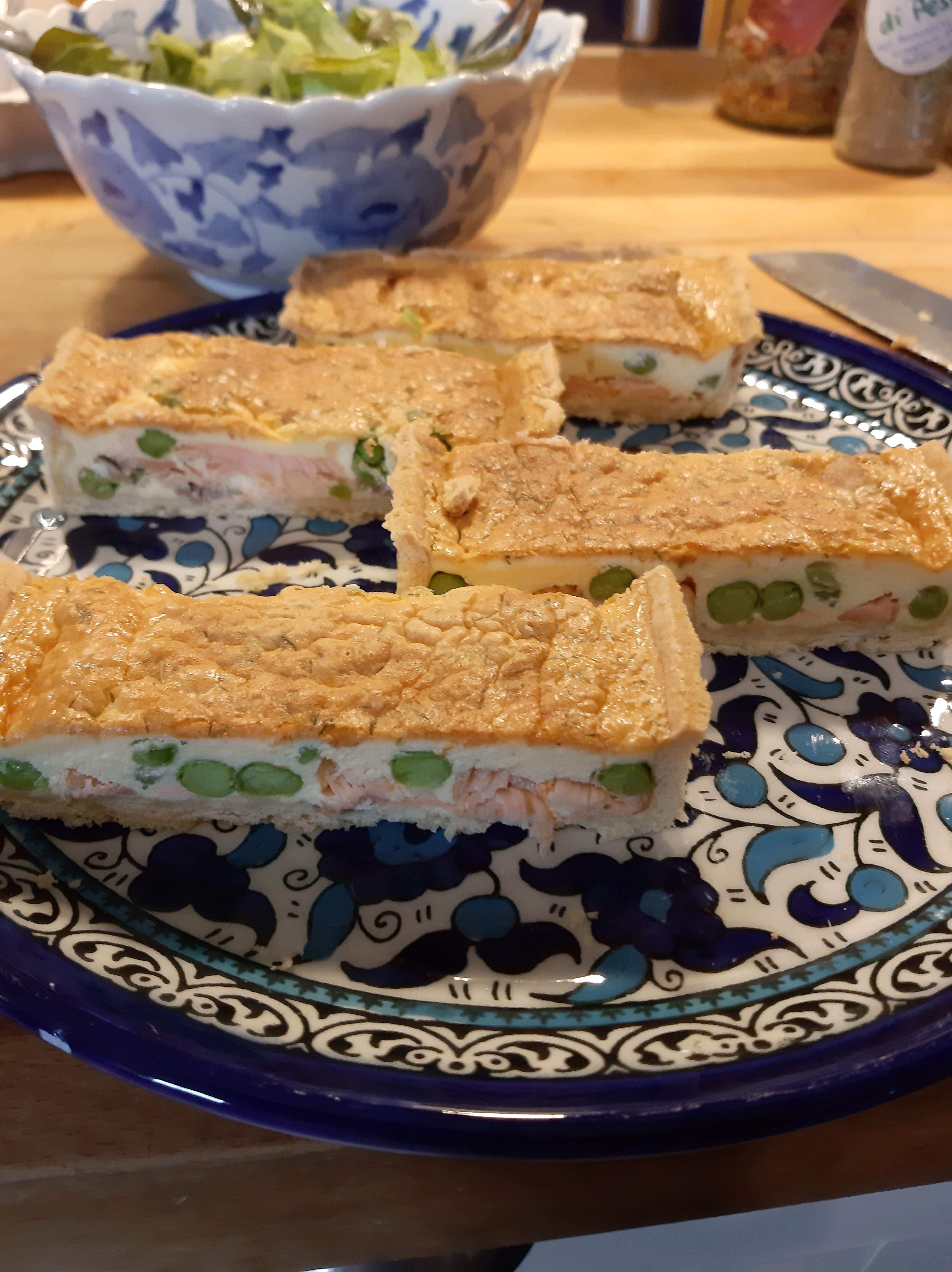
So. Yesterday morning I decided quiche and salad would make the perfect lunch.  I’d intended to have boiled new potatoes too, but completely forgot them at the last minute.  Ah well.

The quiche was going to be one of those fridge leftover scooper uppers, taking in full fat milk; some rashers of bacon, a red onion, frozen broad beans, and a chunk of Coolea cheese left over from G’s birthday.  Oh, and lots and lots of eggs.  And some parsley picked from the doorstep.

Spring quiche

Shortcrust pastry

8oz plain flour

2oz butter, cold from the fridge

2oz lard (cookeen), also cold from the fridge

Some grated parmesan

Salt and pepper, and some harissa style spice mix

  1. Sift the flour into a large bowl
  2. Chop the butter and lard in chunks into the flour
  3. Using your fingertips, rub everything together, lifting it high over the bowl as you go to incorporate air into the mix
  4. When it resembles breadcrumbs (ish) add the seasoning and flavourings if you want them – here I used some leftover parmesan in the fridge and some spicy herb mix
  5. Using a knife mix in enough cold water to form a stiff dough
  6. Squash down a bit (so it’s easier to roll out later) and wrap in clingfilm and leave in the fridge for at least 30 mins.
Quiche filling
3 rashers bacon
1 red onion
knob of butter
a bowl of frozen broad beans
a few spears of asparagus
5 eggs
about 1/2 cup milk
While the pastry is chilling in the fridge grease a tart tin (I used a loose bottomed non-stick tin which must be about 12″ across) and then start preparing the filling ingredients.
  1. Snip the bacon rashers with a pair of scissors into a frying pan (you could of course use a sharp knife, but I find it much easier to use scissors)
  2. Finely chop the red onion and add to the pan with the bacon
  3. Add a knob of butter and cook gently over a medium heat
  4. Meanwhile, if your broad beans need to be peeled again (the grey skin isn’t the nicest flavour, and it doesn’t look too good) then quickly boil them up in a pan with a little water. Boil for a couple of minutes, then rinse in cold water. They are easy to peel – nick the grey skin with your finger nails, then squeeze the bright green beans out of the grey pocket. Yum.  You’ll be surprised how small a bowl you need for the actual beans!
  5. Break the asparagus into roughly inch long sections.  Start by holding the asparagus at both ends and bend it till it breaks.  The end you are holding with the tip is the good stuff.  The other end may be too woody and can be thrown away.  To be honest, in this recipe I ended up using a bit of the woody end too.
  6. By now you can probably take the pastry out of the fridge, roll it out to about 3-4mm and line your well greased tart tin.   Or lots of wee ones if you are making individual quiches.
  7. Prick the base with a fork, leave the pastry draped over the edges while you bake it.  If you don’t the pastry is likely to shrink from the edges and it will be neater if you cook it like this and then cut off the draped edges later.
  8. Roughly cut a piece of greaseproof paper so it is slightly bigger than the tart. Lay this on top of the pastry and cover with baking beans, or ordinary dry beans or rice.
  9. Cook in a hot oven for about 10-15 mins, then remove the paper and the baking beans and cook for a further 3-4 minutes
  10. While it’s in the oven you can crack your eggs into a big bowl and start whisking them – I just use a hand whisk.  Add some milk, or cream if you have any. Or creme fraiche.  You could also add mascarpone cheese or other cream cheese if you have some.
  11. Season with freshly ground black pepper.
  12. Now, neaten the edges of the pastry case, and then start adding the filing.
  13. First, make a layer of bacon and onion.  Then add the broad beans and the then the asparagus.  Grate over some cheese and if you have any herbs add them – I’ve got a couple of pots of parsley by the front door and snipped off a good handful and sprinkled this over the other filling.
  14. You might want to put the tart tin onto another baking tray at this stage, just in case of leakage.
  15. Finally, pour in the eggy mixture and put straight into a hot oven.
  16. It’ll be ready in oh, about 20 – 30 minutes.
You may notice I haven’t got very precise weights, or timings.  I remember when I was still at school and my elder brother had phoned from his university digs to ask mum how long to boil tatties.  She had said ’till they are done’ which has always stuck me as the most sensible answer.
To be fair to my mother, we had an oil-fired rayburn which was on constantly and this forgiving way of cooking meant you never had to focus so carefully on timings.
This quiche is probably enough to feed 8 if you have various other salads and so on with it, if you only have a green salad, then it might only be enough for 6.  Of course, we shared it between two of us, but over several meals.
I think it tastes best still warm rather than hot hot from the oven, or cold from the fridge.

Triple chocolate ginger brownies

6 Jun

This recipe is a bit of an amalgam of several other recipes.  I had decided it was a chocolate brownie weekend.  That was after it had already been a garlic bread, asparagus & parma ham pizza, carrot soup and granary bread weekend.  More on the savoury stuff later, this is all about the chocolate.

So, the amalgam.  I looked at a few recipe books, and the recipe in Leon is the only one which stood out.  It was very particular about the order in which things were added, and also that the melted chocolate and butter should be allowed to cool slightly before mixing with other ingredients, to prevent it seizing up – this makes perfect sense to me now that it’s been mentioned.  They also whipped together the eggs and sugar to make a frothy loveliness before combining with flour/chocolate/butter/whatever else (I seem to recall a lot of orangey stuff, but I’m not a great fan of orange and chocolate).

So, I had some technique to think about from Leon.  And I had an old favourite recipe written out in my old cloth-covered Liberty recipe book.  I wrote it out years ago, and didn’t note where the original recipe came from, I suspect a Good Food magazine.

And on the opposite page from my old tried and tested brownie recipe I have scribbled in the ingredients for Triple Chocolate Brownies.  I made these for the first time when I was looking after my nephews about 2 years ago, and the recipe was either in a book (possibly Delia’s latest?) or ripped out and pinned up on the wall next to the rayburn.  Anyway, I made it, loved it and kept the recipe.

So, I wanted ginger chunks, and found an opened bag of crystallised ginger, you know the stuff all covered in granulated sugar that looks like a cross between a mis-shapen sugar lump and a pineapple chunk.  And I wanted deep chocolatey-ness.  And not too much squelch, more lightness than you might normally associate with a brownie.  And I didn’t want too much sweetness – my original recipe has LOTS of sugar and I felt sure I could lose some of the sugary sweetness without losing any of the nomminess.  I think I succeeded.  But you decide.

Triple chocolate ginger brownies

Grease a 20cm square tin and line with greaseproof paper.  Oven: Gas Mark 4 ish.

150g butter

200g dark chocolate

175g light muscovado sugar

3 eggs

75g plain flour (or use wholewheat if you have it in the cupboard, for a pretendie health improvement, with no associated loss of loveliness)

75g white chocolate

75g milk chocolate

75g crystallised ginger – use ginger in syrup if you can’t find the crystallised stuff, but I think the crystallised is less likely to sink.

  1. Melt butter and dark chocolate over a double boiler.  Use a microwave if you have to, but I prefer being able to heat it gently over water.
  2. You can take it off the heat before it is all melted, especially if you chopped it into smallish chunks before you started.  The residual heat will melt the remaining lumps.
  3. Leave to cool for a wee while, while you get all your other ingredients prepped.
  4. In another bowl, beat the eggs and the sugar together (Using electric beaters) until light in colour and creamy.  It won’t fluff up like egg whites, but it will hold quite a good heavy frothiness.
  5. Chop the remaining chocolate and the ginger into chunks about the half the size of your pinky finger nail.
  6. Now, keep the electric beaters running and gradually add about half of the not-quite-so-hot-now chocolate-butter mixture.  Then mix in the flour, and finally the remaining chocolate-butter mixture. You should have a batter thick enough to fall off a spoon, but not so thin that it just runs off in a liquid stream.
  7. Now stir in the chocolate and ginger chunklets.
  8. Pour into the prepared tin and bake for around 45 minutes.
  9. Cut into teeny squares – I can generally get 16 -20 squares out of the tin.  It’s extremely rich and you only need a wee square to get that chocolatey hit.
For further gingeriness, you could replace some of the sugar with some syrup from a jar of ginger, and even add some ground ginger.  Or grate some fresh ginger and add the juice to the mixture.  Although I possibly only suggest that last one as I recently acquired my mother’s old ginger grater (it is a glass implement, slightly reminiscent of a lemon squeezer gone wrong).
And you could adapt this in many other ways such as:
  • omit all ginger and replace with vanilla paste
  • or omit all ginger and replace with the zest of an orange; use a terry’s chocolate orange cut into chunklets for further orangey-ness
  • add chopped nuts – I think pecans would work well
  • or hazelnuts, and you could replace some of the flour with ground hazelnuts – perhaps a couple of TBsps
  • omit the ginger and instead of adding ordinary chocolate, break in some mint chocolate matchsticks, or whatever they are called – you know the chocolate sticks that look a bit like a chocolate twiglet
  • wee nubbins of marzipan instead of ginger – and replace a couple of TBsps of flour with ground almonds, and add a few drops of almond essence

Cheese scones

19 Mar

I’m moving flat soon.  And as a result I’m staying in a lot, with the intention of clutterbusting.  The other evening the most sensible thing to do seemed to be to clutter bust a kitchen cupboard by using ingredients to bake something, and then get my colleagues to eat it.

So, cheese scones were the chosen baked goods (I have a colleague who can’t eat sugar, so has missed out on many treats in recent months; and I owed him big time for a missed deadline).

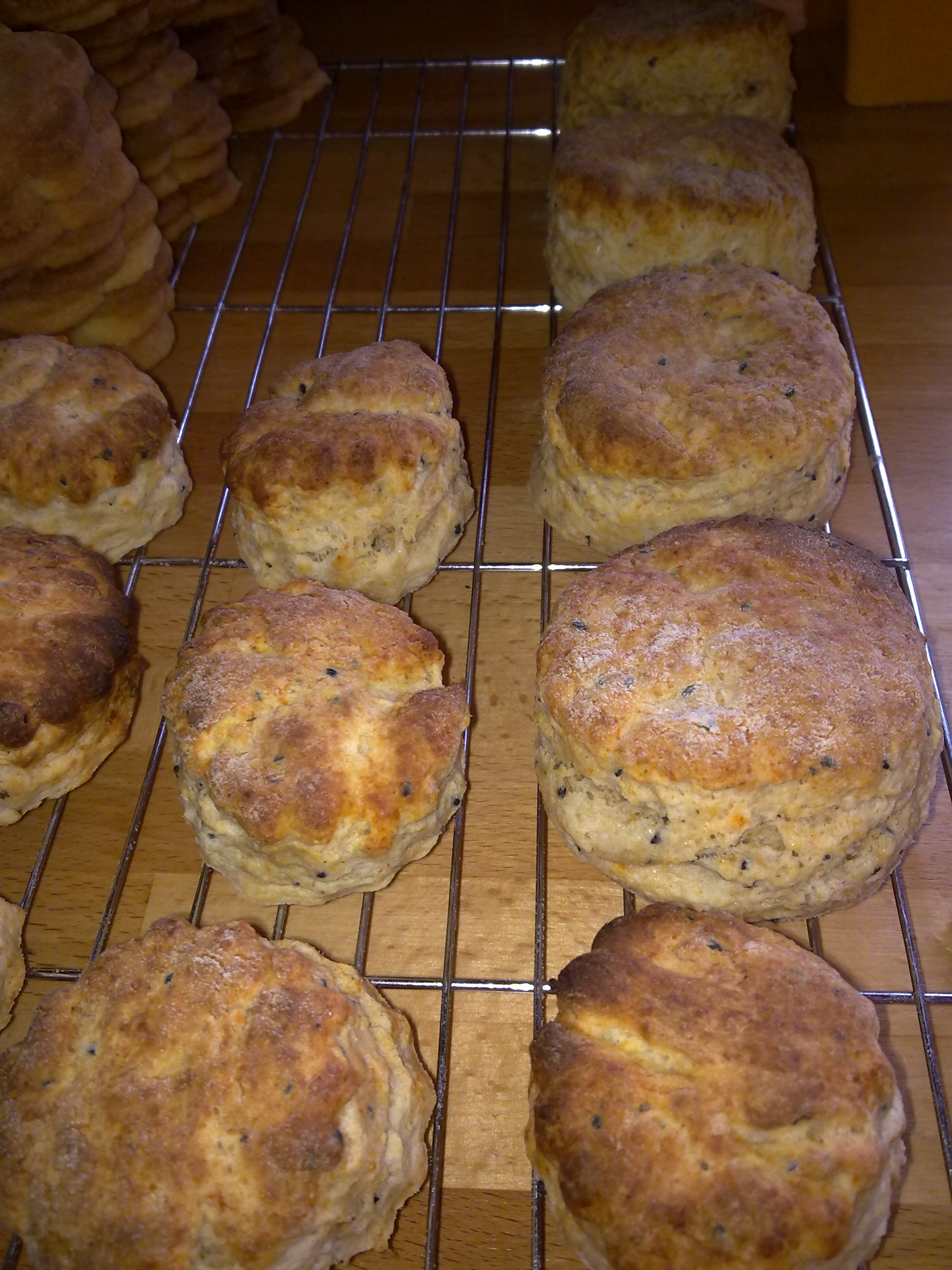
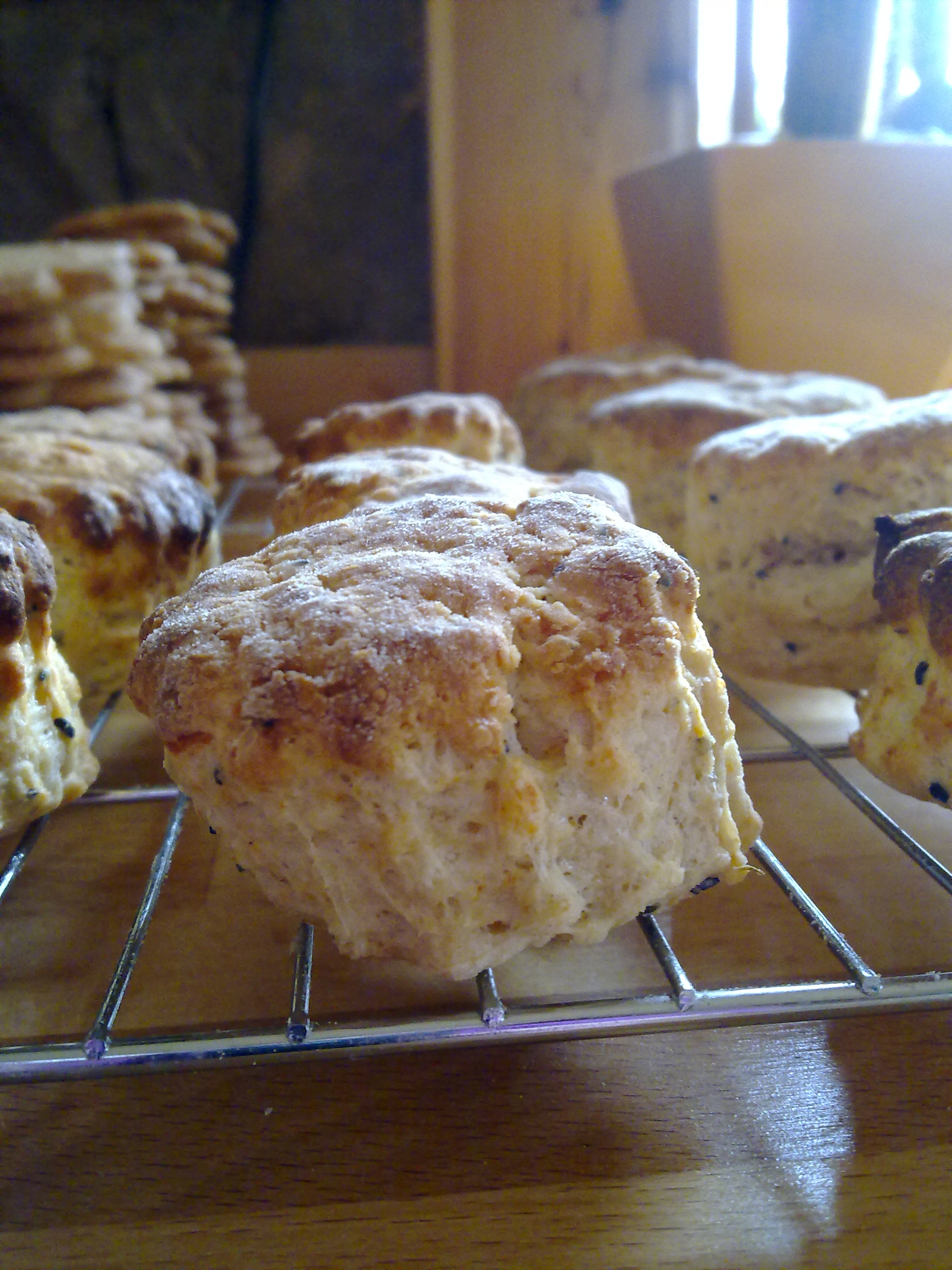
Cheese scones are so easy to make.  In fact all scones are so easy to make.  I should make them more often. These scones were made with a chillie cheddar, so had added spiciness, which is always good.  They were delicious straight out of the oven spread with butter, or the next day heated for 30s in the microwave to re-heat and then spread with butter. Yum.

Spicy cheese scones

140g SR flour

140g wholemeal flour (or plain)

1tsp baking powder

50g butter, straight from the fridge, cut into wee pieces

85g strong cheddar, grated

1 egg

2TBsp natural yoghurt

4 TBsp milk

Heat oven to 190C (fan) or Gas 5.

  1. Mix the flour, baking powder and a pinch of salt in alarge mixing bowl.
  2. Cut in the butter, in wee chunks, and rub in with your fingertips till it resembles breadcrumbs. You could probably use a food processor, or one of those clever pastry maker things, the shape of a horse’s stirrup.
  3. Add any herbs or spices at this stage – sage might be nice; or cayenne, or dried chilli if you like it hot or nigella seeds are quite scrummy.
  4. Stir in about 1/2 of the cheese and then make a well in the centre.
  5. Whisk the remaining ingredients together and pour into the well.
  6. Use a knife to bring all the mixture together to make a soft, but not sticky, dough. Add more milk if the dough is too dry.
  7. Turn onto a floured surface, and either press or roll out to about 2cm thick. Do not overwork, or it will get very tough.
  8. Cut with a knife, or use a cutter. Re-roll the trimmings to use all the dough.
  9. Place on a non-stick baking sheet, and sprinkle each scone with more cheese.
  10. Bake for 10 – 12 minutes until golden
  11. Cool on a wire rack. Or eat immediately.  With butter

Don’t you remember? Scones are the grub that makes the butter go.  Or something.

In case you’re interested, I have another go-to cheese scone recipe. It’s an even quicker recipe with a really good hack for incorporating the butter. Check it out and see which appeals most – they are both super-tasty.

Scone dough

Fresh out of the oven

Perfectly risen cheese scone


Millionaire’s Shortbread

24 Jan

This is surely one of Scotland’s greatest culinary triumphs? Hey, I think of it as Scottish, but perhaps it’s not?  Does anyone know? Also, I note that it is called Caramel Shortbread or Caramel Slice these days.  Do millionaire’s have such a bad press nowadays? Or is it some trades description ruling gone mad?

Anyway, the exquisite combination of smooth creamy chocolate, squishy sweet caramel and crisp shortbread is a true winner.  Traditionally it is served in decent sized slices, but I prefer to cut them into canapé style bite-size squares.  That way you can have one as a wee treat and it’s not toooooo calorific. OK, it is. It probably contains the total recommended calorie intake for a rugby team for a week, but surely that’s what treats are all about?

I wasn’t in my usual kitchen this last week, staying at my Mum and Dad’s, so I didn’t have access to my usual recipe books, or to an easy internet connection to look up recipes online.  I found a shortbread recipe, which I adapted, in a charity cookbook.  And I guessed with the caramel, and it seemed to work well.

Millionaire’s Shortbread

6oz butter

3oz caster sugar (I used vanilla sugar, out of the jar)

6oz plain flour

1oz custard powder

For the caramel

1 large tin of condensed milk

about 2oz butter

about 2 oz caster sugar (vanilla sugar again will give it a lovely subtle vanilla-y flavour)

a wee bit of milk if necessary

A very large block of Dairy Milk chocolate

So, I started the night before, making the caramel.

  1. Put the condensed milk, butter and sugar in a heavy based pan and warm gently.
  2. Stir constantly for a good ten minutes, or possibly more until it is a delicious golden toffee colour. You could test it at this stage, by dropping a wee bit on a cold saucer and seeing if it’s a squishy consistency when it cools. Once it seemed ready, I walked away and spent the rest of the evening watching Brideshead Revisited on DVD.
  3. Now for the shortbread – Beat the butter and sugar together until light and fluffy.  This will be oh so much easier if you start with soft butter, so if you have a cold kitchen you might want to leave it in a warm place for an hour or two, or soften it in the microwave if you have such a thing.  Being at home, I left mine beside the Rayburn overnight, and it was perfect.
  4. Now add the flour and custard powder.  You should probably add a wee teeny pinch of salt too, although I’m not sure it’s entirely necessary and in these days of trying to reduce our salt intake it probably is no longer recommended.
  5. Mix all together to form a dough.  Don’t be over vigorous about this, as I think it makes a better crisp bisuit if it’s not over-worked.
  6. Press into a buttered tin, and prick it all over with a fork.  Cook in a moderate oven (it was a Rayburn, I don’t have any more precise details than ‘moderate’) until it’s golden and ready. Yes, I said “until it’s ready”, probably at least 30 mins, possibly longer.
  7. While it was in the oven you could turn your attention back to the caramel.
  8. Here’s the cunning bit – as the caramel is now cool, you will be able to tell if it has the right consistency.  If it is too solid, just warm it gently (really gently) in the pan and add some milk to loosen it.  Stir it well once it’s warm. If it’s too runny then you’ll need to boil it up for longer (but this wasn’t an issue with me).
  9. At the same time you could be melting the chocolate in a bowl over a pan of water.
  10. When the shortbread is ready bring it out of the oven, and leave it in the tin. Spread the warm caramel over the shortbread.
  11. Leave it for a few wee minutes to cool slightly and then pour the melted chocolate over the caramel. Give the tin a wee shoogle to settle all the chocolate evenly and smoothly.
  12. Leave in a cool place, and carefully cut into bite-size chunks.

Sugar biscuits

1 Jan

These are a classic roll ’em and cut ’em out biscuit.  They are plain, in that they are vanilla flavoured, although the recipe suggests you could add some finely chopped nuts or coconut to the recipe.  I’ve never tried this, and not sure it would be worth it.  Sometimes you are just in the mood for an ordinary biscuit.

Sugar biscuits

175g / 7oz SR flour

pinch of salt

25g / 1oz cornflour

100g / 4oz butter

100g / 4oz caster sugar

1 egg (or it says you can use 2 egg yolks, which I guess would work if you were making meringues, or a mousse)

1/4 tsp vanilla essence

a little milk

More caster sugar, or glace icing for dredging once they are cooked

Grease 2 or 3 baking sheets. Oven 200ºC / 400ºF / Gas Mark 6.

  1. Sift the flour, salt and cornflour into a bowl.  I don’t think you need to do this any more.  This is an old book – I must have bought it in 1979 – and in those days the flour needed to be sifted.  The milling process has since improved and there is less need to sift flour for baking).
  2. Add the butter in wee chunks (straight from the fridge, it works best if cold) and rub in with your fingers until the mixture resembles breadcrumbs.  Try to add air into the mixture at this stage, by lifting your hands up from the mixture to rub, and letting it drizzle back down through your fingers.
  3. Beat together the egg and the vanilla essence and add to the mixture.
  4. Mix together and slightly knead to form a fairly soft dough.  Add a little milk if necessary.
  5. Wrap in cling film or  foil and leave to cool in the fridge for 30 minutes.
  6. Turn the dough out onto a lightly floured surface and roll out to about 5mm / 1/4″ thick.  Use whatever cookie cutters you have to cut shapes (preferably about 5cm / 2″ diameter) and place on the baking sheets.
  7. Bake in the pre-heated moderately hot oven for 8 – 10 mins or until lightly golden brown.
  8. Remove to a wire rack and either dredge with caster sugar while still warm, or wait until they cool and ice with glace icing.

This should make 30 – 40 biscuits.

This recipe is from one of my oldest and most loved and used recipe books: Cakes and Cake Decorating by Rosemary Wadey.  I bought it when I was in my early teens, and spent many a happy weekend and evening trying out new recipes.  I ticked each recipe off as I tried it at one point, but sadly left no notes, or other comment, such as a date.

I fell in love with the Grantham Gingers, a surprisingly hollow wee dome shaped biscuit, light and crisp, and delicately gingery.  And then there were the Danish Pastries – a triumph! And after my grandfather died, I made virtually every teabread in the book for his wake.   Perhaps it was then that I first discovered the  therapeutic power of getting into the kitchen and baking.