Tag Archives: recipe

Cheese and onion tart

14 Feb

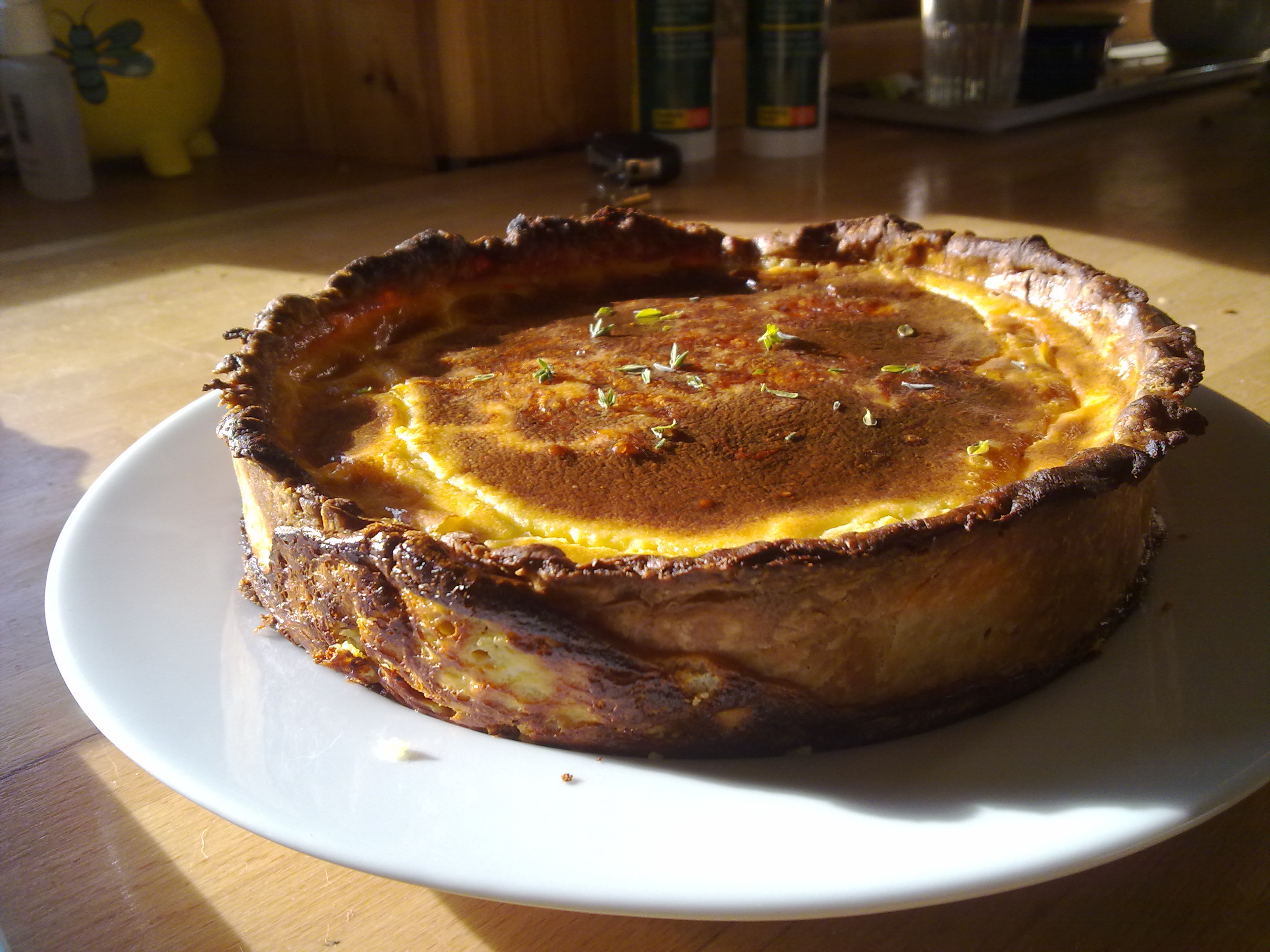
Cheese and caramelised onion tart

I bought one of those value bags of onions the other week.

And I still seemed to have a huge bagful of onions in the kitchen this morning. What to do? Well the first obvious recipe was french onion soup. I have several recipes for french onion soup, but for some reason went for a new recipe: Nigel Slater’s Onion Soup with Madeira and Gruyere Toasts.  The picture of it looks oozingly and unctiously dark and delicious.  But mine wasn’t. He uses chicken stock instead of the traditional beef. I have no problem with this – I’ve often made onion soup with chicken stock. But I’ve no idea how he managed to get his soup so dark in colour, without a beef stock, as mine is light in colour, as you’d expect.

But, we didn’t have onion soup for lunch. And the dough for the baps remained in the bread machine till later in the afternoon.

And I got started on a better lunch solution: Cheese and Onion Tart.  This was clearly a far more sensible lunch, as it made use of not only a whole load of onions, but also some leftover cream, leftover pastry and a lump of cheese from the fridge. I love a fridge-sweep to make something new, delicious and unexpected. Why hadn’t I thought of this sooner?

Cheese and caramelised onion tart

  • Shortcrust pastry made with 4oz flour
  • a big glug of olive oil
  • a big slice of butter, about 25g
  • 4 large onions, cut in half from end to end, and then thinly sliced into half moons
  • 2 soupspoonfuls of muscovado sugar
  • 1 egg, plus 2 extra yolks
  • about 200ml cream
  • about 50ml whole milk
  • 2 soupspoonfuls of cream cheese
  • 50g mature cheddar cheese
  • 2 tsp dijon mustard
  • a few sprigs of fresh thyme

Preheat your oven to 200C or GM7. Butter a sponge sandwich tin (well, that’s what I used, a 23cm round tin with a loose bottom).

  1. Roll out the pastry and line the tin with it. Place the tin on top of a baking sheet – it’ll make everything so much easier later on. Put back in the fridge for 20 minutes.
  2. Prick the base with a fork, then cover the pastry with some baking paper and baking beans. Put in the hot oven for 12 minutes.
  3. Remove the baking beans, turn the oven down to 180C / GM4 and return the pastry to the oven for 5 minutes.
  4. While the pastry is in the oven (for the first time) put the oil, butter and onions in a heavy bottomed frying pan and heat on an oh so gentle heat for 25 minutes with the lid on. You might want to stir them from time to time, but not too often, as you need to keep the lid on to retain their liquid. After 25 minutes they should still be pale in colour, but have a certain sticky gloopiness about them.
  5. Now remove the lid from the onions, stir in the sugar, and cook the onions for a further 10 – 15 mins, till nicely caramelised, and the liquid has all but evaporated.
  6. Whisk the egg and the yolks together in a big bowl. Add the cream cheese, the cream and the milk and mix. Add the grated cheddar, and season with lots of freshly ground black pepper.
  7. Spread the base of the pastry case with the dijon mustard.
  8. Pick the thyme leaves off the stems and fold them through the onions, then spread on top of the mustard
  9. Pour the cheesy, eggy, creamy mix over the top of the onions and carefully slide the whole thing into the oven.
  10. Bake for about 35 minutes – the tart should still have a wee bit of a wibble wobble about it.

Serve with boiled new potatoes and a salad. It’s best at room temperature, or a wee bit warmer.

Yeah... it tasted good

A midweek tart

9 Feb

If you have a notion to make a tart mid-week, and you don’t get home till about 7pm then you really need to use bought pastry.

And if your rolling pin is in the country and you are in the city, then you need to use pre-rolled bought pastry.

So, I swallowed my pride and bought pre-rolled shortcrust pastry tonight. I think it may be a first. And now that my pride is well and truly swallowed, I can admit that it probably won’t be the last!

My notion was to make a rich chocolate tart. I’d been thinking of rich chocolate tart since before breakfast (I know, I know, this isn’t healthy behaviour) and then I went out to lunch with the lovely PAtothecity and she told me all about her fabulous Hotel Chocolat experience yesterday evening, including chilli hot chocolate. She asked how to make chilli hot choc, and I have a sneaky feeling I read a recipe for it just the other day, but have NO IDEA where, probably somewhere on this world wide web. Anyway, I suggested she split a chilli in half longways, de-seeded it and then popped the chilli in a pan with the milk. Warm it up and steep the chilli milk for a few minutes (depending on desired heat). Then remove the chillis, and add the chocolate, and warm to the right temperature for your hot choc.

With this in mind, I decided my chocolate tart would be a chilli chocolate tart. A RICH chilli chocolate tart. A rich chilli chocolate tart with sea salt flakes.

Rich chilli chocolate tart with sea salt flakes

Rich chilli chocolate tart with sea salt flakes

Preheat oven to 180C or Gas Mark 4. Grease a 23cm/9″ tart tin.

  • A packet of ready rolled short crust pastry, or if you have time, make your own pastry
  • 300ml double cream
  • a couple of fresh red chillis
  • 2 tsp caster sugar
  • 50g unsalted butter
  • 200g dark chocolate
  • a big glug of full fat milk
  • some maldon sea salt
  1. Line the prepared tin with your rolled out pastry. Cover the pastry with a large piece of baking paper and fill the paper with dry chick peas, or baking beans* or rice, or whatever you can find in a packet or jar to weigh down the pastry.
  2. Bake for 10-15 minutes
  3. Take the pastry out of the oven and remove the paper and the baking beans
  4. Return the pastry to the oven and bake for another 15 minutes, till golden brown
  5. While it’s in the oven you can get going on the rich chocolatey-ness
  6. Cut the chillis in half longways, and de-seed. Put them in a saucepan with  the cream and warm up to not-quite-boiling
  7. Leave to steep for a wee minute or two, and then remove the chillies (and throw them away)
  8. Add the sugar and a pinch of salt to the cream and heat back up till it boils. Remove from the heat immediately, and add the butter and chocolate (broken into chunks) to the pan
  9. Beat with a wooden spoon till all melted and glossy and nummy
  10. Put aside for a wee minute or ten (depending on how cold your kitchen is – mine is freezing, so I just left it for a couple of minutes and it had cooled down quite a bit) and then add a glug or two of milk (about what you’d add to a mug of coffee.
  11. Keep beating till it comes all glossy again
  12. Now, if your pastry shell has just come out of the oven you’ll need it to cool a wee bit before you go any further
  13. Once both shell and chocolatey goodness are cool-ish pour the choc mixture into the shell.  Cool at room temperature, and then sprinkle with sea salt flakes
* Please do NOT use baked beans. It will get messy and will taste disgusting

If you have a hot kitchen, or if you like really cold things, cool it further down in the fridge. But personally, I’d serve it at room temperature, with a scoop of creme fraiche.

Now, all I have to do is work out how to get it to the office tomorrow morning.

And, given that St Valentine’s Day is next week, this might be an appropriate recipe for wooing your loved one. It would certainly work for me, but then I’m particularly susceptible to that chocolatey, salty, hot chilli combo of flavours. And not too sweet.  All I need to know now is what wine to serve with it, as I suspect that it won’t work with fizz. Better ask Convivium Wine.

Beetroot cheesy muffins

2 Feb

I owe some colleagues some home baking. I’d promised one muffins and another doesn’t eat sugar, so it was clearly time to make another batch of  savoury muffins.  It would have been the Parmesan and Courgette Muffins again, if Tesco’s had any courgettes. But at 7pm I wasn’t about to go traipsing round town hunting down a courgette, so beetroots became a worthy substitute.

Now, if only I’d consulted with the facebook fairies before  I went shopping – the recipe could have been enhanced with feta cheese, goats’ milk, smoked salmon and creme fraiche. But there’s always next time.

Pink savoury mufflets

Savoury beetroot mufflets (a mufflet being a mini muffin)

8oz plain flour

1tsp baking powder

4 small beetroot, cooked and coarsely grated

2oz parmesan, finely grated

2oz mature cheddar, finely grated

200ml milk

about 1/3 tub of plain yoghurt

1 egg, beaten

75ml olive oil

about 3 -4 fresh sage leaves, finely chopped

Line a muffin pan with paper muffin cases.

  1. Mix together flour and baking powder in a big bowl (everything else will be poured in here eventually)
  2. Add beetroot and cheese and mix – try to get rid of the claggy lumps of beetroot
  3. In a separate bowl, mix the oil, milk, yoghurt and egg together. Add the herbs
  4. Pour the wet ingredients into the dry, and mix quickly together. Don’t over-mix, just bring everything together so the pink colour suffuses the whole mixture and it has no lumps of flour. The mixture needs to be quite soft and wet, but not runny
  5. Spoon a large soup spoonful of mixture into each muffin case
  6. Bake for 20 minutes (or until golden) in a medium hot oven (Gas Mark 5)

OK – they are out of the oven now. They are more like mufflets than muffins, slightly on the wee size, and not quite enough oomph in the flavour. So this is what I would do differently next time:

  1. Use baking powder that wasn’t past its best
  2. Use the correct size tin for the muffin cases
  3. Swap the milk and yoghurt for goats milk and yoghurt (thanks cousin!)
  4. Add some salt and pepper
  5. Use more sage or some nutmeg, or possibly orange zest, or dill, that would work
  6. Add some finely chopped scallions
  7. Cut some of the milk by volume, as the mixture was a bit too sloppy

Go on, have a go yourself – they are too easy.

And yes, they would be just delicious with a dollop of creme fraiche and some smoked salmon on top. Thanks Barry Bryson.

Tollhouse cookies

30 Jan

Tollhouse Cookies are a memory from my childhood. I had a recipe written in my childish hand-writing, which if memory serves me correctly had the list of ingredients but no instructions. I made them so often I didn’t need instructions and so I knew that they were the most delicious of cookies.

I’m pretty sure the recipe came from my Aunt Joyce, the Queen of Baking in my world. And I’m also fairly certain that the recipe is in my mother’s recipe book. So, if I really wanted I could no doubt get back the original, and make them exactly as they were in those eternally sunny summers back in the mid 70s. But I also recall that they had half lard, half butter (or even marg) … and I know that using half lard can make pastry beautifully short, but I don’t think I want to use lard in my biscuits any more. So, if I’m going to play about with the recipe anyway, I may as well just find a new one, and adapt from there.

So, this weekend I did some internet research, so you don’t have to.  Although if you really want to find out more, you can do worse than starting out here on my friend wikipedia.

Now, a bit of background for you. One of the reasons I feel quite so strongly about Tollhouse Cookies might be because my father’s office was in the original Tollhouse in our town.  I know it’s purely circumstantial, and literally hundreds of towns must have their own historical tollhouses, so clearly my recipe was no more authentic than any other. But, my recipe had choc chips AND nuts and I am not about to mess with my memory by either making a Tollhouse Cookie with no nuts, or re-naming the biscuits of my childhood Choc Chip n Nut Cookies.

But anyway, the research revealed a few things about 21st century tollhouse cookies: the butter should be melted and the sugar needs to be a mixture of brown/muscovado and caster – this will give a more caramelly taste and chewy texture, which works for me. And the cookies should be left on their baking sheet once nearly cooked so they complete the cooking out of the oven. No-one seemed to want to put nuts in them though, so feel free to omit them if you want. But then please just call them choc chip cookies.

Tollhouse cookies

Preheat oven to 170C or Gas Mark 3. Grease at least two baking sheets. Or I guess you could line them with baking parchment instead.

170g unsalted butter

250g plain flour

1/2 tsp bicarb of soda

1/2 tsp salt

200g dark brown or muscovado sugar

100g light brown sugar (or caster)

1 TBSp vanilla extract

1 egg + 1 egg yolk

200g dark chocolate, chopped into wee chips

125g mixed nuts, chopped into wee chips. I’ve not tried it, but you could probably use salted nuts if you’re a fan of the sugar-salt-choc thing.

  1. Melt the butter in a big bowl (this is the bowl that the whole mixture is going to end up in so make it big enough). I use a microwave to melt the butter, but of course you could melt it in a pan and then tip it into the bowl.
  2. Sift the flour, bicarb and salt together in a different bowl – this is really just to mix it together, as most flour these days doesn’t need sifting – but it’s an old habit with me, so I like to sift it all
  3. Add the sugars to the melted butter and beat with an electric beater (or a wooden spoon if you want to work off those bingo wings) until you have a light fluffy mixture
  4. Now add the vanilla essence and the eggs and beat some more
  5. Mix in the flour and stuff with a wooden spoon, then mix through the nuts and chocolate chips
  6. Depending how warm your kitchen is, you’ll either have a soft-ish batter, or a much stiffer dough… my kitchen was baltic this weekend, so the butter cooled down quickly and I had quite a stiff dough
  7. Now, how big do you want your cookies? I use about a soup-spoonful of mixture in a big lump, and they spread out to around 3-4 inches diameter.  But you might want to make ENORMOUS cookies like those ones you get at train stations… you’d probably need about 4 TBsps of cookie mixture for that size.
  8. Remember to leave gaps between each dollop of mixture – the larger the dollop the bigger the gap required. For the enormous ones you’ll need at least 3″ I’d say.
  9. Bake for about 16 minutes, but this will depend on which shelf they are on in your oven, how hot the oven actually is and what size you’ve made your cookies. Ideally you need to take them out when they are golden around the edges, but not toasted in the middle. Leave them on the baking tray to cool down, they will continue to cook. Then remove them to a cooling tray. This will give you a slightly chewy cookie, if you prefer them crisper, just keep them in the oven a wee bit longer, till they are uniformly coloured.
  10. Once they are cool, transfer them into two separate airtight containers. Keep one lot at home, and take the rest to your colleagues, or to someone you love (not mutually exclusive).

There!  How easy was that? And according to my colleagues, they’re a winner.
But before you run off to bake cookies, a top tip for you. Some of you will know this already, but if you’re not a baker you might not. Don’t keep opening the oven door to check your cookies, and when you do open the door, be sure to shut it gently afterwards, as slamming it shut will blow in cold air, and mess with the cooking. This is even more important when you’re baking cakes, or anything you expect to rise. If you slam the door, it’s like slamming a big weight onto your delicate cake.

Roasted peppers in a jar

14 Jan

A jar of summery goodness

I love roasted peppers in a jar.  Well, they don’t have to be in a jar, they can be in any container you want really, but they can look pretty so why would you hide them in plastic, or one of those lovely brown stoneware pate dishes?  As an aside, I’m very fond of those brown stoneware dishes – they conjure up happy memories of home. At lunchtime there always seemed to be something delicious in a brown stoneware pot: mackerel pate, pork rillettes, roasted peppers in olive oil, etc.

But, it’s glass jars all the way for me these days, apart from anything else, I can seal them up and take them with me on a Monday morning to the flat in Edinburgh, or the office for jazzing up tasty lunches.

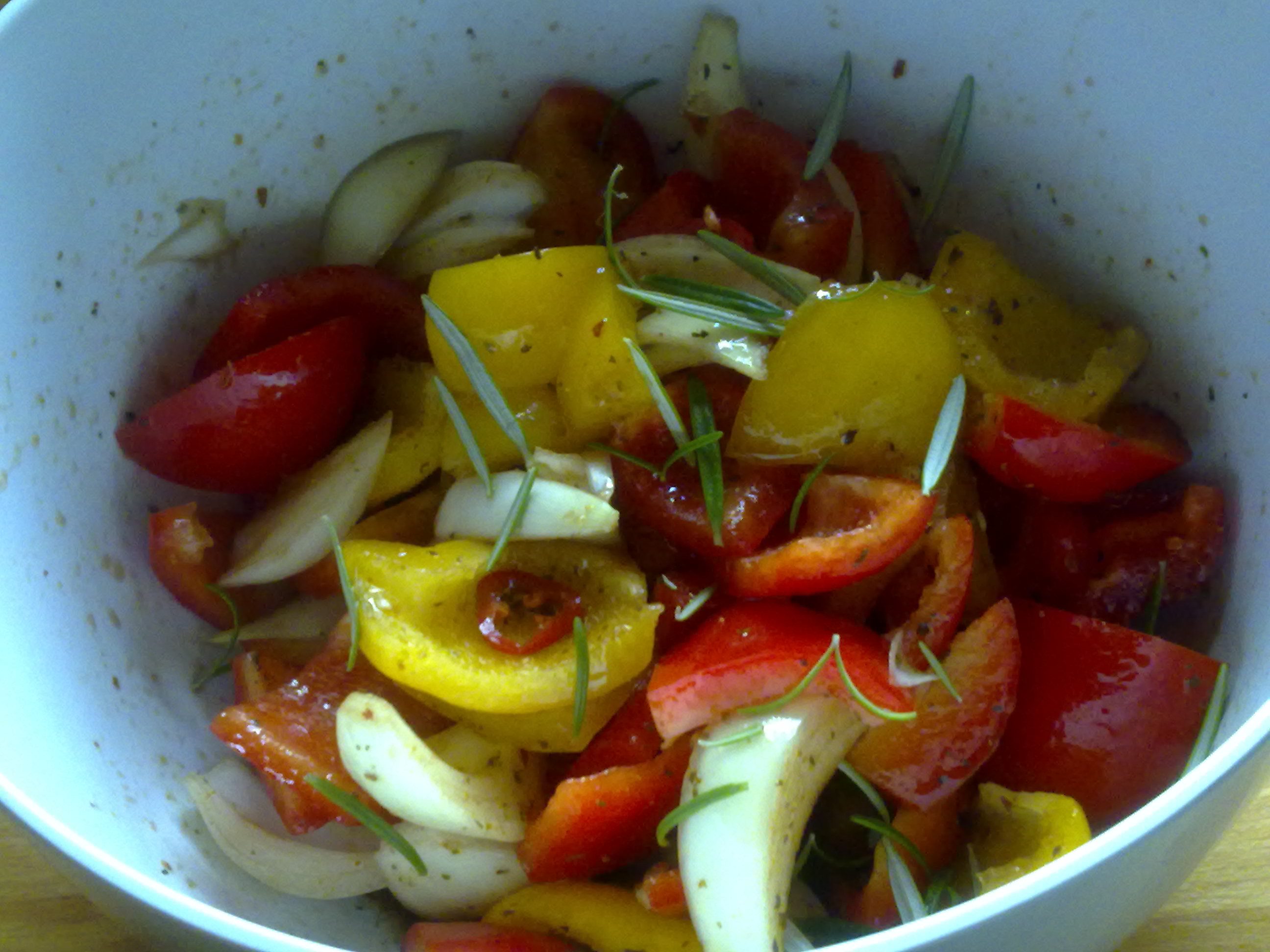
Chop everything into a big bowl

Place in a single layer on a baking tray

Roast till peppers are soft and you have caramelised edges

Pop them in a jar

Slow roasted peppers in a jar

3 bell peppers – you can use any colours, but in my experience green peppers often end up looking a wee bit grey, so I prefer to use 2 red and one yellow.

At least 2 big cloves of garlic

2 small onions, or one large

a large sprig of rosemary

a couple of small bay leaves

a red chilli pepper

a glug or so of balsamic vinegar

a tsp honey, if you want it

any other herbs, spices that you fancy – eg thyme, cayenne pepper

a good pouring of olive oil (if you have any at the bottom of a jar of sun dried tomatoes, anchovies, or artichokes, or other such tasty goodies, then use that)

more olive oil – you’ll need enough to cover the peppers once they are in the jar

a grinding or two of black pepper

a mere sprinkle of maldon sea salt

  1. Chop the peppers into large chunks – I like mine about 1.5″ across. Put them in a big bowl.
  2. Cut the onions in half from top to bottom. Lay it on the chopping board on its cut side, and then cut it into wedges. Depending on the size of onion you’ll get 3 – 5 wedges. Add them to the bowl with the peppers.
  3. Place the flat side of a large knife on top of the garlic clove, and then smash it with your fist – this will release the garlic easily from its papery skin and will also give you a nicely smooshy clove.  You still want it pretty much whole(ish) but all squished so you benefit from the release of all that tasty juiciness. Yup, throw these in on top of the peppers and onions too.
  4. Chop the chilli and add as much of it as you want – if you don’t like heat, don’t bother.  I like heat in most foods, but this doesn’t need much, if any, so feel free to omit it.
  5. Strip the rosemary from its stalks and throw the leaves into the bowl.
  6. Add any other herbs and spices you are using.
  7. Now today I had a jar of honey that was solidifying in the jar, so I added a tsp or so of honey into a wee mug and poured a wee bit of boiling water on top and stirred till it was liquid. Then I added a big splish splosh of balsamic vinegar and a good glug or two of olive oil. Mix all this together and add it to the bowl.
  8. Mix all the ingredients together to coat everything in the dressing.
  9. Pour into a single layer onto a baking sheet and sprinkle with a grinding of black pepper and a wee sprinkle of maldon sea salt.  Don’t bother if you only have table salt.
  10. Pop in a medium oven (it was gas mark 3 ish I think).

You’ll probably smell when it’s ready.  Did it take about 45 minutes?  I don’t really know. You don’t want crispy burnt bits, but you do want soft peppers and caramelised brown edges on some of the onions and peppers.

Cool for a bit, then put into a jar. Pour over enough olive oil so the peppers are covered and keep in a fridge for a week or two.  You can eat it immediately if you want, but it’s really nicest after all the flavours have had a chance to infuse in the jar, so I would leave it a couple of hours at least.

In the summer months, you might want to add slices of courgette or aubergine to this. Or beetroot in the autumn. And if you want mushrooms, add mushrooms.

Eat it as a salad accompaniment, or with cold meats, in a sandwich with hummus, or added to a bowl of soup (if you’re doing this don’t do it straight out of the fridge or it will be a bit weird, although I know Nigel Slater would argue for that juxtaposition of hot and cold). Or I’m sure you’ll find other ways of using it to jazz up your meals.

Fishy fishy

8 Jan

I did a REALLY stupid thing yesterday.

After a rare shopping expedition to Sainsburys, instead of my usual, closer Tesco, I left my hand bag hanging on the trolley when I left it at the trolley park.  I’d been home an hour, and had unpacked all the shopping before I realised what a muppet I’d been.

I phoned the store straight away and the bag had been handed in and was waiting for me at customer service, so I went back to retrieve it.  I was amazed that everything was still in it, from my cuter-than-a-button lego notebook (seriously it is like a great big piece of your favourite lego and you can write in it) to my mobile phone (OK, it’s just confirmation that my phone is a piece of shit) and my purse with all its cards in it.  Thanks Sainsburys customer, I think I love you.  And I will forward the good karma to someone else.

I was determined to stick to my shopping list yesterday. I have a habit of going off-piste in a supermarket, but one of my aims for this year is to get better at planning and sticking to those plans, and not just in relation to supermarket shopping.

But I like seeing what is fresh, and seasonal when I shop.  And I can easily be seduced by a bargain, especially if it’s in the ballpark of the list. So, fish was on the list. I want to eat more fish this year (see, I should just write a proper list shouldn’t I of all the things I want to achieve this year?).

And the fish pie mix was on special – half price, so I bought 300g of fish pie mix.  And a bag of mussels.  Mussels will be eaten today. They weren’t on the list, but trying new recipes is, so that’s ok!  The fish was yesterday’s supper – not a fish pie as such though, because the potatoes I’ve got don’t mash well. I know, why do I have a bag of new potatoes at this time of year?  But I do, and they are lovely just boiled, but not so good any other way.

Anyway, this is what I did.

Fish Gratin

300g mixed fish, cut into large cubes

2 leeks

knobs of butter

a TBsp or so of flour

about 1/2 pint of milk

about 4 TBsp double cream (optional – only used as there was some in the fridge which needed to be used)

a fish stock cube (or a veg one, or just use salt and pepper to taste)

a tsp dijon mustard

a few threads of saffron (again, optional, but I had some in the cupboard)

1/2 cup of fresh breadcrumbs

about 2 TBsp grated strong cheddar or other strong-flavoured hard cheese

Gas Mark 7 or 8

If you’re having potatoes with this, prepare them first, and put them in a pan of water.  If you’re a quick cook then start boiling them now, before you start the fish gratin, otherwise put them on to boil once you are half way through.

  1. Melt a knob of butter in a pan over a medium-low heat
  2. Slice the leeks down their length and then cut them into half moon slices and gently cook them in the butter till they are soft, but not browned
  3. Tip the leeks into a gratin dish and spread over the base
  4. Put the saffron fronds into a wee cup or dish and cover with a wee bit of hot water, from the tap is fine
  5. Add another knob of butter to the pan the leeks were in and melt it
  6. Stir in some flour to make a roux
  7. Add the milk, bit by bit, stirring all the while so it doesn’t go lumpy.  I added some hot water from the potato pot at this point.  You’re looking for a sauce that easily coats the back of the wooden spoon – but if it’s too thick, just add more water/milk.
  8. Stir in the fish stock cube, the mustard and the saffron water. Stir to make sure the fish stock cube is melted in properly and then add the cream
  9. Add the fish to the sauce and gently stir together
  10. Pour the fish mix on top of the leeks
  11. Sprinkle breadcrumbs and cheese on top and put in a hot oven
  12. Cook till it’s bubbling and the top is crispy crunchy and a caramel brown colour.  Mine was in for about 15 mins, but it could be in longer at a lower temp if it suited your plans better.

This was served with boiled potatoes and brussels sprouts.  Now, I never used to be a fan of brussels sprouts, but the man is and so I’ve discovered various ways to make them scrumptious and my vegetable of choice!  Oh yes, not just leftovers, I choose to buy and cook them!

Brussels sprouts with chestnuts

About 7 brussels sprouts per person

a knob of butter

A few roasted chestnuts

  1. Prepare the sprouts by chopping off their ends and the very outer leaves.  You don’t need to do anything else, no crosses in their bottoms are necessary, but if this is your traditional way of doing them, feel free to indulge
  2. Put them in a pan so they form a single layer on the bottom of the pan and add about 1/4 cup of water (this was for two people, you’ll need more if there are more sprouts in a bigger pan I suppose).  I use enough that I think will have all but disappeared in about 8 minutes of boiling (this recipe is an art, not a science.. or it is the way I’m writing it.  I guess I could be more scientific about it if I really tried but for now this is all you’re getting I’m afraid)
  3. Put the lid on the pan and bring to the boil. Once it’s boiling, sit the lid on the edge of the pan, so it’s covering the pan but let’s a little steam out. Jiggle them around from time to time. If you run out of water, add some more hot from a kettle
  4. Once they look cooked (about 7-8 minutes I think) and there’s not much water left at all, add a knob of butter to the pan and jiggle them around again.
  5. Then crumble in the roasted chestnuts, and jiggle around some more over the heat
  6. Done!

You may have noticed I don’t add salt to many things as I go along. I used to, but a few years ago tried to cut down on salt intake when my blood pressure was slightly higher than was desirable.  I stopped adding salt to pans of boiling water – pasta, potatoes, vegetables, rice… and I discovered that after the first few days none of them needed it, or not in the blanket coverage way I used to add salt.  I now occasionally add salt at the end, when I taste it and think it needs some, but more often than not I don’t.  I probably wouldn’t get anywhere on Masterchef but my blood pressure is fine.

Banana goodness

3 Jan

So, most weeks I’ll buy some bananas at the supermarket, as I know he’ll take a banana to work each day, and it’s a way of getting towards that 5-a-day of fruit and veg.  I hadn’t really thought through the whole Christmas/New Year thing and how it might interrupt his banana consumption.  So, this morning I decided to do something with the three blackening bananas left on the side in the kitchen.

Banana loaf was the obvious choice.  Or I have a good foolproof and adaptable banana muffin recipe. But if I’m going to make muffins in the next 24 hours, it’s going to be vodka-soaked-cranberry muffins, using the cranberries from my vanilla cranberry vodka which are currently in the freezer waiting to be enjoyed.

So, I turned to the internet for inspiration and good old Nigel Slater came up trumps again. He calls it black banana cake.  And I’m not sure if that is a reference to the state the bananas are in before you start, or the fact there is plenty chocolate in there, so the cake will be darker than you might expect for a banana cake.  I figure it’s probably the former.  As ever, I vaguely modified the recipe as I went along, but you can find his original here.

Banana choc nut cake

175g/6oz unsalted butter, softened in the microwave as it’s so cold in the kitchen.  In fact it was softened so much that some of it was melted, and I had to beat it back together again

175g/6oz sugar (half golden caster, half light soft brown muscovado type sugar)

75g/2 ½ oz mixed nuts (Nigel wanted hazelnuts but I had mixed in the cupboard so that’s what I used)

2 free range eggs

175g/6oz SR flour

2 very ripe bananas (Nigel asks for about 250g/9oz in weight, but all I know is I used two ENORMOUS bananas)

About ½ tsp vanilla essence (Nigel only wanted a single drop)

175g/6oz good quality dark chocolate chopped into rough chunks

A little Demerara sugar

Preheat oven to 170C/325F/GM3

Line the base and sides of a 20cm x 12cm / 8in x 5in loaf tin.  I used a 1lb loaf tin – cake is still in the oven so I’ll find out soon if it was big enough (it was!)

  1. Toast the nuts.  Rub them in a tea towel to remove their skins if you can be bothered (I didn’t) and then grind them in a food processor, or with a zizzer or whatever implement you have to grind nuts. You’re looking for a pretty fine consistency – a bit like sand. I used a hand held zizzer, you know the kind of thing you’d usually use to blend soups.
  2. Beat the butter with the sugar till light and fluffy
  3. Add the eggs one by one and beat into the butter and sugar mixture.
  4. Mix in the nuts and SR flour.
  5. Peel the bananas and chop them into small pieces into the bowl with the sugar/butter/egg mixture.
  6. Gently fold in the vanilla, bananas and chocolate nuggets into the cake mixture. Don’t overmix.
  7. Shlop into the prepared loaf tin. Dust with a little Demerara sugar (I forgot to do this, and doubt it will matter too much).
  8. Bake for 1hr – 1hr 10 mins, covering the top with foil if the top looks like it’s about to burn.

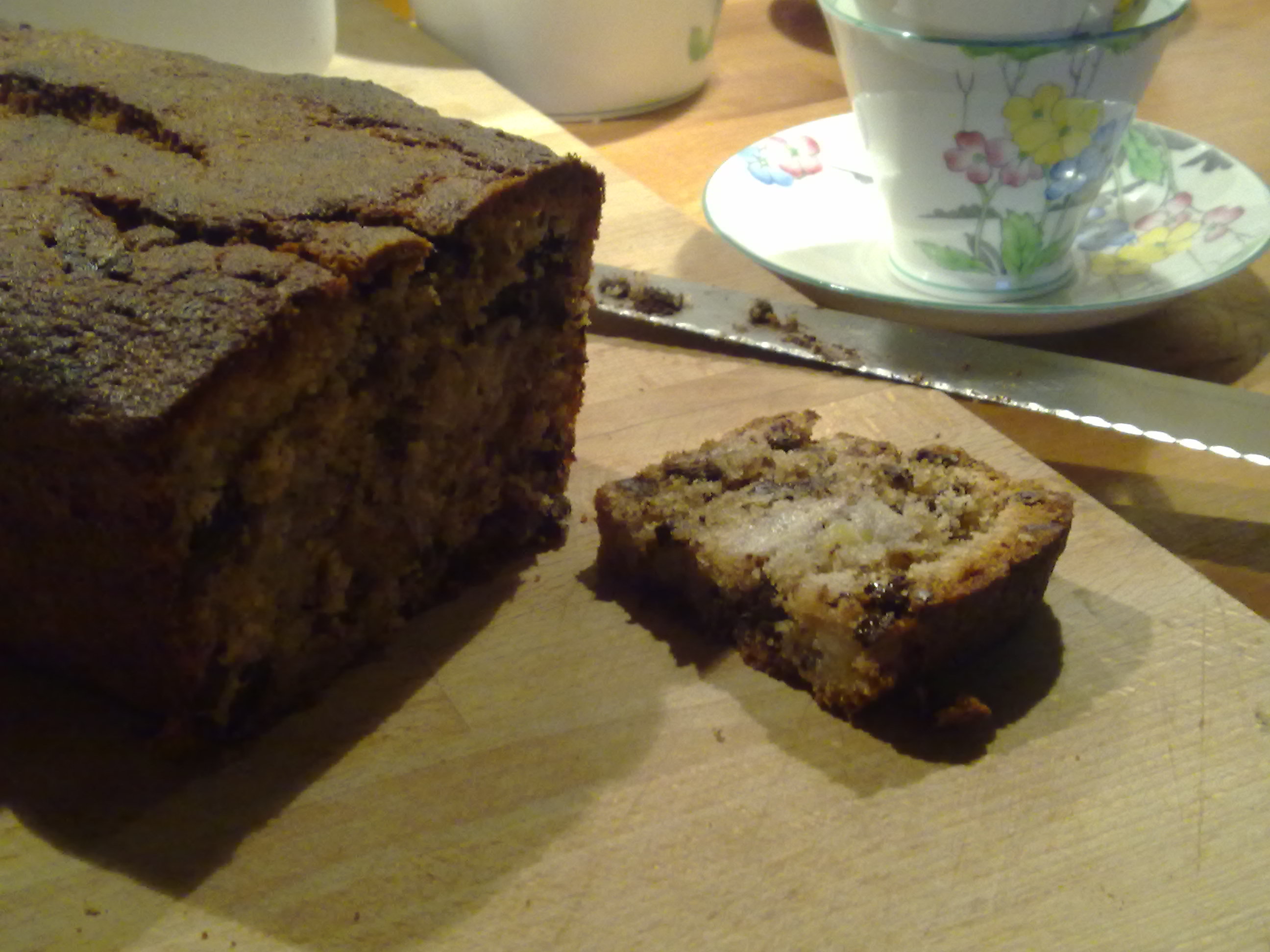
Oh my world, it’s amazing!  Lovely light texture, strong zing of chocolate when you get a nugget of it.  And gentle banana flavour running through it all.  Scrum.  Eat with a cup of Earl Grey tea, in a china teacup of course.

Banana choc nut cake anyone?

Hilda Gerber’s Chocolate Sauce

20 Dec

Hilda Gerber’s chocolate sauce is amazing.

It’s amazingly naughty and amazingly rich and for me an amazingly strong memory of Christmas and Hogmanay from my childhood.  It’s also ridiculously easy to make.  And once you can make Hilda Gerbers (the sauce is always just called Hilda Gerbers in our family) you can make the infamous Meringue Mountain, all gloriously seventies.

Hilda Gerber was a cookery writer in the 30s and 40s in South Africa.  But I knew none of this back when I was a child. A quick google and I discover that her manuscript for Traditional Cooking of the Cape Malays was found and published after her death in 1954. The Cape Malays were the descendents of slaves and political exiles, mostly from Indonesia and Bengal, who were brought to the Cape of Good Hope in the 17th and 18th century by the Dutch East India Company.  Their name derives from the trader language they spoke, called Malayu.  During the apartheid years any Cape Malay who converted from Islam to Christianity was reclassified as Cape Coloured. Their spices and condiments from the East, which arrived on the ships on their way back to Holland, pepped up the blander Dutch recipes in their colonial kitchens.

I intend to seek out some Malay recipes – I think the only one I have is Bobotie from my Aunt Joyce.  But surely I can get a Bredie recipe from my Aunt Astri?  And I’ve wanted to make mebos (delicious nuggets of salty-sweet dried fruit) for AGES but I suspect Scotland does not have the climate for drying fruit.

Anyway, allegedly Hilda Gerber used to ask local Malay women for recipes, so she could record them for posterity and compile a recipe book.  Some of the Malay women silently sabotaged her efforts to create an indigenous cookbook, and would miss out a key ingredient, such as the milk in potato pudding, so any efforts to make it will end up with potato scrambled eggs.  Hmmm, I’ll bet you’re not wanting to make this chocolate sauce now?

Anyway, all of that I have discovered in the last 24 hours, but Hilda Gerbers (the sauce) has been known to me all my life.  I wasn’t exactly weaned on it (although if I was it would go some way to explaining my current size) but it was always there on special occasions.  I suspect the recipe came via my grandmother who lived for many years from the 30s through to the 80s in South Africa.  So, here we go:

Hilda Gerbers Rich Chocolate Sauce

4oz dark chocolate

4oz icing sugar

4 eggs

8oz butter

  1. In a bowl over a pan of water, melt the chocolate.  Make sure the bowl is big enough to take everything, as all the other ingredients will be added to this later.
  2. Once melted, add the icing sugar.  You’ll think it’s all gone badly wrong, when it turns into rubble, but trust me, it’s ok.
  3. Add eggs and beat in, one by one.  Keep warm, but do NOT boil. It’s looking a bit better now, huh?
  4. Now take off the heat and cut the butter into chunks into the mixture.  Stir a bit, but leave to melt in and then stir a bit again
  5. That’s it.
  6. Leave it somewhere cool. Then eat.

Or, instead of just eating it by the spoonful, make a Meringue Mountain.

Make some meringues, the more the better.  Big ones, little ones, medium ones.  Crunchy ones and chewy ones.  Just lots.

And beat some cream, with a wee bit of sugar and vanilla if you want, but it’s not really necessary.

Now make the mountain. Stick some meringues to the bottom of your dish with a dab of cream.  Now squidge some cream on top of the meringues, so you can add another layer.  And keep going with layers of meringue and cream until you have a mountain.  Then pour the chocolate sauce over the top.  You’ll need to have taken it out of the fridge a while before pouring, or it just won’t pour.  Think about it, it’s mostly butter and chocolate which are quite solid in a fridge.

You can do all manner of other things with it other than the Meringue Mountain, but remember it is incredibly rich – so you won’t need much of it.  I suspect it would be good with a teeny tiny chocolate brownie and some vanilla icecream.  Or have I just gone too far?

Oh, and don’t even think of giving this to pregnant women. Or getting pregnant while you’re eating it.  DANGER.

I’m about to go make a batch to have on Christmas Eve.

Bacon maple brownies

11 Dec

Thank you Nigella.  They’re in the oven, so I don’t know yet if they are to die for, or a waste of some perfectly good ingredients.  The constituent parts were scrummy (well, I had to lick the spoon after scraping the brownie batter into the tin, and the baconny-syrupy scraps on the plate were just asking to be licked up).

But really?  Bacon in chocolate brownies?  I totally see where you came from with this – bacon and maple syrup pancakes are divine.  And as a child I remember the treat that was bacon with fried bread and honey. Now, whatever happened to fried bread?  Did the health Nazis get rid of it for good? Possibly not the worst decision ever made, but still divine in my childhood memory.

Anyway, Nigella sent me a recipe for Bacon Brownies.  Well, she didn’t just send it to me, it was sent out to anyone who subscribed to whatever style thingy she’s guest editing this week.  And now I’m wondering if it was all just a big hoax, to see what muppets would actually make it.  Well, here I am, prize muppet! I give you Bacon Maple Brownies, inspired by Nigella, but not exactly the same.

Bacon maple brownies

Preheat oven to 190C / 375F / GM5

(OK, now I see why my finished brownies seem even gooier than they should be, I had the oven not quite hot enough).

Grease and line a 25cm square brownie tin.  Or Nigella does it in a throw away tin, of course she does.  Her hands aren’t made for washing up.  And it’s so much easier to take a gift of brownies when you pop in to your neighbours if they are in a throw away dish!

100g thin rashers of streaky bacon, snipped or chopped into teeny weeny pieces

2tsp maple syrup (or golden syrup)

150g unsalted butter

250g soft light brown sugar

75g cocoa powder

150g plain flour

1 tsp bicarbonate of soda

4 large eggs, beaten

150g chopped chocolate (dark, or milk)

  1. Heat a heavy frying pan and then add the bacon bits, and fry till they are just going crispy
  2. Add the syrup, and mix quickly, then pour the whole bacony syrupy mixture onto a plate to cool
  3. In a large heavy pan melt the butter over a low heat.  This is the pan the whole batter will be made, so make it big enough
  4. Once the butter is melted, remove from the heat and stir in the sugar with a wooden spoon.  Bash out the sugary lumps (unless you anticipated this and sifted it in advance).
  5. While the butter was melting you should have put the flour, cocoa and bicarb into a bowl and mixed it.  And cracked the eggs into a bowl and beaten them.
  6. Once the sugar and butter are mixed, add the flour mixture and stir it in
  7. Add the beaten eggs, and stir all together
  8. Throw in the chopped chocolate, and then use your finger to nudge all the bacon off the plate into the chocolate batter. Lick your fingers.  And wonder if this was all a hoax and you should have just made ordinary brownies, and had maple syrupy bacon bits as a separate snack.
  9. Mix all together
  10. Pour the batter into the prepared tin and bake for 25 mins or so.  It will still be slightly wobbly, so you have ultimate gooeyness in your brownies.  But if you cook it at the right temperature it shouldn’t be too gooey.
  11. Leave to cool in the tin, then remove and cut into pieces.  Not too small, but not too big pieces.  You know, a couple of decent mouthfuls.

Don’t tell anyone what is in them

Mine are out of the oven now and I’ve decided it’s not a hoax – they are divine.  That sweet yet salty hit of a wee nubbin of bacon is just perfect in the rich gooeyness of the brownie.  They may not be glamorous, but oh my god they are tasty.

Eat your greens… introducing the greenest soup ever

10 Dec

This morning I had the most delicious breakfast: buttery scrambled eggs and grilled rashers of smoked back bacon from our local butcher.  I really don’t miss my carbs at breakfast time!

My heliboy was out on a mission (fitting a friend’s dishwasher) so I was without a car and kicking around the house.  I could have gone out and put all the garden furniture back where it belonged, after Hurrican Bawbag did its worst on Thursday.  But my wellies were in the car, on the mission.

So, I knitted for a while (Christmas gifts to be made) and then poked around the fridge to see what soup I could make for lunch.  It wasn’t terribly inspiring I have to say, but there was a bag of spinach, and a leek and some onions and potatoes.  It was looking like spinach soup.

Spinach soup

A knob of butter

1 leek

1 onion

1 medium-large potato

1 bag of spinach

chicken stock cube

some grated nutmeg

  1. Finely chop the onion, peel and chop the potato into small chunks, and slice the leek.  I prefer to cut the leek lengthwise and then chop it, so all the slices are half moons.
  2. Melt the butter in a heavy based saucepan, and chuck the chopped veg in on top
  3. Sweat the veg, stirring regularly
  4. Grate in about 1/2 tsp nutmeg, adn throw in the chicken stock cube
  5. Pour in boiling water.  Oh, I don’t know how much, about 3/4 kettle full I think
  6. Stir, then leave to simmer for about 15-20 minutes (and I really don’t care if you leave the lid on or not while it’s simmering)
  7. Check the potato and onion are cooked, then add the whole bag of spinach to the soup
  8. The spinach will quickly wilt down – stir it through and let it simmer for another 3-4 minutes
  9. Zizz it up with a hand held zizzer.  Or do it in a liquidiser if you like washing up
  10. It won’t go completely smooth, but will be completely tasty
  11. Test for seasoning – add freshly ground black pepper and more nutmeg if needed
  12. It would look pretty with a swirl of cream, or a dod of creme fraiche.

This is a subtle, light soup and would make a lovely starter to a big rich meal.  Or even a not so big rich meal.  Enjoy.