
Archive | Recipes RSS feed for this section

Going to work on an egg (or the arrival of my Greek heroes)

13 Oct

People who know me may know that for some years now I have wanted to have chickens. I don’t really know when this desire first rooted in my heart, but I suspect it was long long ago on summer holidays up at Marbrack, a Galloway hill farm where my Aunt Joyce lived (with my Uncle Frank and 5 of my cousins).

Marbrack had one of those lovely farmhouse kitchens, the real heart of the home. We all sat on a long wooden bench at the even longer kitchen table, with our backs warmed by the rayburn behind us. The same rayburn which occasionally would bring a wee cold dying lamb back to life in the bottom oven (or have I made that bit up?). And the same rayburn which produced all manner of delicious teatime treats, including scotch pancakes (drop scones) freshly made directly on the hot plate.

Anyway, I think we went to stay a few days every summer holidays. My memory is of being a hopelessly shy child, especially around all my big boy cousins, so I spent most of the time close to Aunt Joyce’s apron strings. Spending time in the kitchen was bliss – there was the huge bowl of fresh milk to be brought in from the back kitchen, so I could skim off the cream from the top. And there were cakes to bake. But best of all, there were hens. Each day we would take a pail of scraps out to the hens, and then would look for the eggs. Thinking about it, now I know why there were so many cakes – all those eggs to use up!

For years I lived in London and there was no possibility of having hens in a basement flat, so it wasn’t until my life changed a few years ago that I thought about being able to have my own chickens.

And now that I live in the country I have my own three wee chook chooks.

And thanks to The Song of Achilles being our recent book group book, two of the chickens are named after Greek heroes – well, one Greek hero and one Prince of Troy: Achilles and Hector. The third is called wee Tommy.

And yes, I know these are boys names.

Two things:

  1. I don’t suppose chickens know the difference between a girls and a boys name
  2. If by chance they do, I feel very comfortable with gender dysmorphic / transgender chickens in my coop. And they seem very comfortable with it too.
l to r: wee Tommy, Achilles, Hector

And after three days I’m getting three eggs a day from these wee heroes. When I go out in the morning and call them they come running out of their wee hen house to see what treats I might have brought them, and they peck around my feet. I’ve learnt that shoes with shiny buckles are too enticing for chickens. And that a corn on the cob on a string is the best sport for chickens in a coop.

So, there will be many more pictures, and many recipes for what to do with an egg laid by a Trojan Prince. But for now, I give you my failsafe boiled egg for breakfast recipe.

The perfect boiled egg

Now, of course if you have access to a super fresh egg, straight from a Trojan Prince that is what you should use. Otherwise, just use an egg from an egg box. But I hope your egg is at least free range – those batteries are nasty places, and I hate to think of hens cooped up with no space to move about and be inately henny.

And where do you keep your eggs? Mine are kept at room temperature, so they are at the same temperature as everything else when I am baking cakes. I don’t see the point of keeping them in a fridge, they don’t need it. Or not in our cold kitchen anyway! If you have a larder that is where I would keep them.
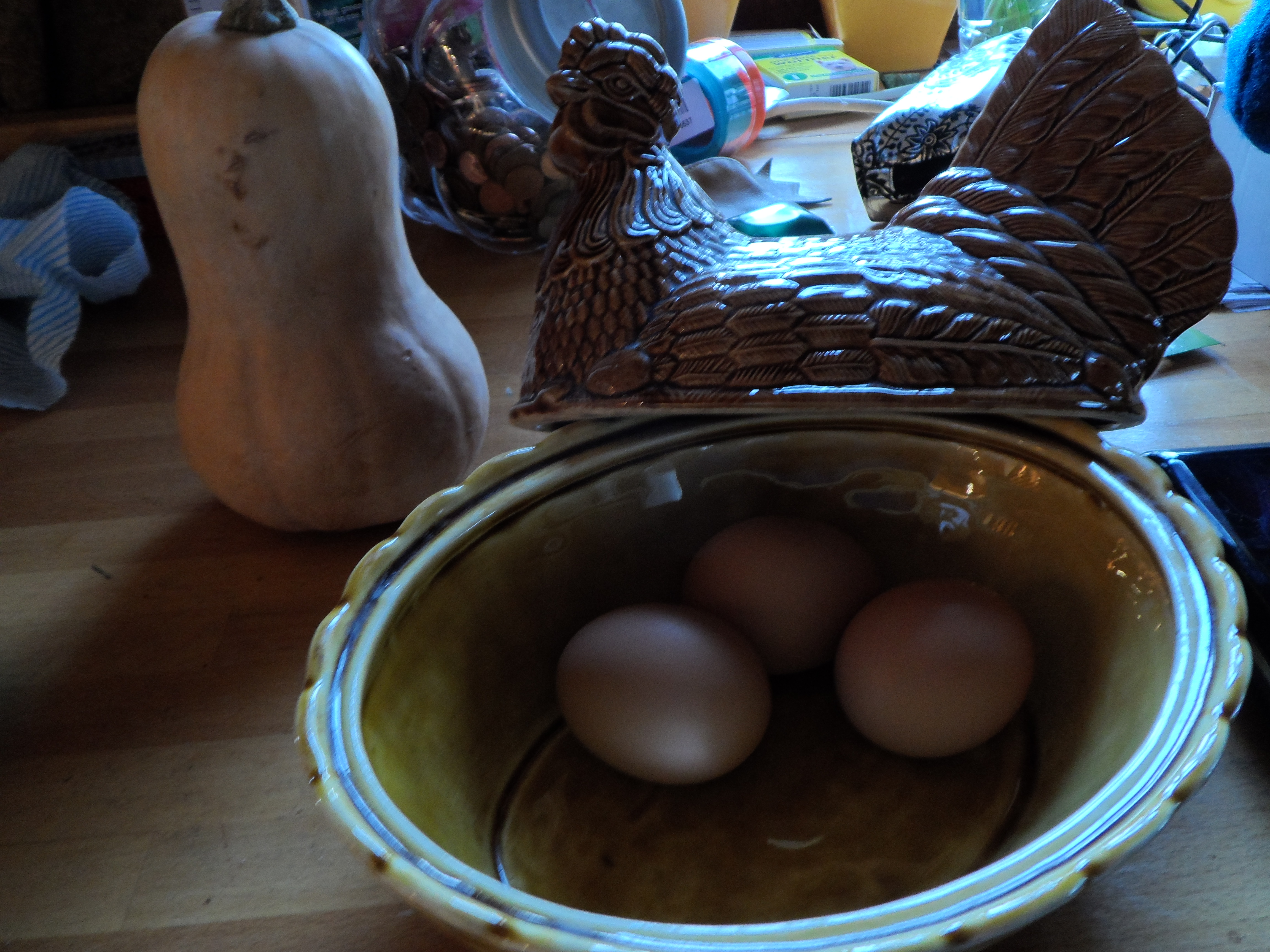
The best place for eggs

Anyway.

Get a small saucepan, and pop your egg in the bottom of the pan. Pour water over the egg, so the egg is just covered with water. If your egg is super fresh it will sit on the bottom of the pan. If it’s been around a wee while one end might bob up to the top, which is fine. If the whole thing properly floats I would chuck it – it’s been around too long and may be icky.

Place the pan over the heat – a medium heat is fine – and bring to the boil.

At this point you should make your toast if you want any.

Once the water is properly boiling, put your timer on for one minute. The water should be properly boiling, not like wild rapids so the egg is being thrown about the pan, and not a wee soft simmer, but something in between.

After a minute, take the pan off the heat.

Get your egg cup ready and pop your egg on the egg cup; if you have an egg cosy, use it – it’s probably something that will make you smile, and we should never deny ourselves the wee joys in our world. Your egg should be at that delicious soft yolk stage. And all you need with it is a scrunch of black pepper, and a teaspoon for breakfast perfection. Of course if you made that toast, then a single slice of hot buttered toast works (perhaps with a scraping of marmite, if you’re feeling in need of a salty hit and some B vitamins).

For a low carb diet a boiled egg (or two) for breakfast is just perfect – in fact for everyone it is the best start to the day, with a wee hit of protein to get you up and keep you going till lunchtime.

Soft boiled egg – the breakfast of champions

Autumn baking

3 Oct

So, it’s October. I’m not entirely sure where September went, but it seems to have been and gone and now we are truly in the grip of Autumn. So, apart from all that lovely Autumnal weather (which is just an excuse to knit and wear a bright scarf) and Autumnal colours (yup, when you have a wood at the bottom of your garden you hardly need television this time of year) there is all that lovely Autumnal cooking and baking.

And this weekend I suggest you make your Christmas cake. Yes, really. Just do it. The smell in the kitchen is awesome, and the baking is relatively simple (although you will need several large bowls). And come Christmas you’ll be so glad you baked it early.

I’ve made this cake for the last few years – last year I made it in late November, but for various reasons it wasn’t eaten till June. It had been wrapped in cling film, then silver foil and just left under the stairs for months. And oh my it was sensational. So, bake now; eat later. You’ll thank me.

I added 1/4 again to this recipe as my tin was 23cm. When I say I added 1/4 again I mean approximately 1/4 again. Some people say that baking is an exact science and for some recipes it absolutely is, but this cake is forgiving. And so long as the totals of nuts vs dried fruit is about right it’ll be ok. I hope.

Here we go. Light Christmas Cake. Make it now. And again next month for a wee late January treat.

Vegetable broth (and croutons if you want them)

21 Sep

It’s clearly the beginning of the soup season. The days are cooler, and the evenings are outright cold. Yesterday it rained and rained and rained all day. Today it’s still cold, but it’s gloriously sunny and I’ve already got two loads of laundry merrily blowing on the whirligig line.

It’s not just nature that is going through a period of change. My life is also changing. Quite dramatically really.

A couple of weeks ago I moved house. I had been living in two places: a lovely wee colonies flat in Leith, in Edinburgh, through the week and in the Clyde Valley with my boyfriend, the Captain, at weekends. Each Friday after work I would travel west to the Valley and the each Monday morning I would travel back east to the Capital. At one level I had the best of both worlds: the city life (and all the benefits of living in a truly wonderful capital city) through the week and then the joy of having a relatively big garden and being surrounded by fields at the weekend.

But in all honesty it was no longer my dream. My dream was to live in one place, and to know that I would have the right accessories to go with whatever clothes I put on in the morning. All too often that perfect necklace was in the other house.

So just after this year’s festival was over I packed all my worldly belongings into boxes and moved out west. And here I am. Sitting in the garden room, looking out onto the garden and across the Clyde Valley. The clouds are just beginning to blow in, and the trees are starting to lose their lush green. Autumn is definitely in the air. So it’s most definitely the season for warming soups.

After yesterday’s smooth carrot soup, I wanted something chunkier today. And I had a hankering for pearl barley. This the perfect soup for using up whatever veg need to be used. Today it was turnip, carrot, potato and leeks. Oh and savoy cabbage, which didn’t really NEED to be used, but I wanted it.

Anyways, here goes, another simple recipe to see you through the Autumn and Winter.

Vegetable broth with croutons

Vegetable broth

  • A splash of oil, or a smudge of butter
  • A couple of leeks, washed of dirt, then sliced finely
  • A carrot, peeled and cut into small chunks
  • A medium potato, peeled and cut into the same size(ish) chunks
  • Turnip, peeled and cut into the same size chunks – I used a piece about the same size as the potato, maybe slightly larger
  • A handful of pearl barley
  • 1 1/2 stock cubes (veg, lamb or beef work well)
  • A few big outside leaves of savoy cabbage, the central spine removed and sliced finely
  • Parsley
  1. Put the oil/butter in the bottom of a large heavy based pan over a medium/low heat
  2. Put a kettle of water on to boil at this stage
  3. Add the leeks, the carrot, the potato, the turnip. Just add them as you chop them up, they don’t all need to go in at once
  4. Sweat the veg for a few minutes, stirring to stop them from sticking/burning
  5. Add the pearl barley and stir
  6. Add a good few grinds of black pepper and the stock cubes and a wee bit of water, just to wet the pan, and cook for a further minute or two
  7. Add the kettleful of water, stir, and bring back to the boil
  8. Simmer for about an hour, till the whole thing is looking thick and gloopy and the barley is soft
  9. Add the savoy cabbage and cook for a further 5 minutes or so
  10. Serve with a sprinkling of chopped parsley. It doesn’t need croutons, but I couldn’t resist them.

If you have any bay leaves throw one or two in while it’s simmering, and if you have celery in the fridge, then cut some up and add it all in with the other veg. Somehow, I never seem to have any celery around though.

Croutons

  • Whatever’s left of an old loaf of bread
  • Olive oil
  • Celery salt
  • Black pepper
  • Herbs and Spices (I have a harissa style spice mix, with chilli, garlic, coriander and who knows what else)
  1. Cut the bread into thick slices. Then cut each slice into long batons. Then cut each baton into chunks. They don’t need to be precisely the same size, but it’s best if they are similar sized chunks
  2. In a big bowl, pour some oil around the sides of the bowl so it dribbles down into the bottom of the bowl. You don’t need a lot, but enough that the inside of the bowl is coated in a thin film of oil
  3. Now sprinkle in your chosen flavours – I grind lots of black pepper, then a sprinkle or two of celery salt, followed by a good skoosh or the harissa spice mix
  4. Now through in the bread chunks and gently mix it all around. A
    good squidgy spatula is the best implement for this. What you’re trying to do is to give all the bits of bread a chance of absorbing a wee bit of the flavoured oil. The chunks should not all look soaked in oil, although some of them might. But really, you’re trying to make this with as little oil as you need
  5. Pour the coated bread into a baking tray and pop in a very low oven
  6. I leave it for about 45 mins in an oven at gas mark 2. But this is not a precise recipe – check on the croutons and take them out when they are ready – they will have taken on a slightly golden colour and will be slightly crispy (they crisp up a bit more as they cool down).
  7. Sprinkle in your bowl of soup, or serve them in a pretty bowl so people can help themselves. If you have any left keep them in an airtight tub for a few days.

Please don’t use good fresh bread for these – the bread will be much nicer just served in chunks with the soup. But if you have the heel of a loaf left, just take 5 minutes to make these and then you’ll have them ready for next time you have soup (which surely won’t be long away).

Carrot soup

20 Sep

I say ‘carrot soup’ but really this could be any root veg soup. But seriously this is the easiest thing in the world to make. If you can cut with a knife you can make this soup.

Pimped up carrot soup

Before you start I should fess up. It’s not strictly a carrot soup, as I add some lentils to it – to give it a bit of body and also add some protein. If you want to omit the lentils do, and it will be ready much quicker too. But I’d be tempted to throw in a wee sprinkle of flour and mix it in before adding the water, to thicken it slightly.

Carrot soup

  • 1 large onion, chopped as best you can
  • about 6 medium/large carrots, peeled and chopped into chunks
  • a dash of oil
  • 1tsp or so ground coriander
  • about 1/3 cup red lentils
  • 1 Knorr chicken stock cube
  1. Using a heavy bottomed pan, splash the oil into the bottom of the pan and ‘sweat’ the onion and carrots over a gentle heat.
  2. At this point you should put a kettle full of water on to boil
  3. Add the coriander, the lentils and the stock cube and continue to cook for a few minutes, stirring well to prevent it burning or sticking to the bottom of the pan
  4. Pour the kettleful of water into the pan, and bring to a simmering boil
  5. Simmer for about 45 minutes
  6. Pour into a liquidiser and zizz it up till it’s beautifully smooth
  7. Serve – feel free to glamorise it with some yoghurt and/or a sprinkle of parsley. Or croutons. I’ll tell you about my croutons another day.

There are lots of ways to play about with the recipe – grate some orange zest and squeeze some orange juice into it; add some harissa paste; add other root veg – parsnips and turnip would work well.

And of course you can use this same basic principle, of sweating veg then adding liquid to make all manner of other soups – swap out the onion and carrot for leeks and potatoes, or keep the onions and use butternut squash instead of carrots.

Sourdough

20 Sep

So, I start my sourdough starter today. I’m expecting good things from this – I have an exceptional guide: Sourdough by Yoke Mardewi and I have the right products (OK, so that’s just wholewheat rye flour and water) so what could possibly go wrong?

There will be photographic evidence as I go along, so keep coming back to see how it goes.


Apricot upside down cake

23 Jul

When life gives you apricots, you should just eat them. But when you still have more apricots than you know what to do with a week later, and they are in danger of going off, you should make cake with them.

A soft, caramelly number would be perfect. Perhaps with some ground almonds to give a hint of marzipan and add extra moistness.

And if it was served with vanilla ice cream it would be just about perfect.

So, that’s what I intended to do yesterday, with some urgency once I discovered that the Captain’s daughter was coming over for lunch with her 2 year old daughter too. But we had no butter. So the Captain was instructed to get a pack of butter when he picked up the papers. And it had to be real butter, not some spread masquerading as butter.

He returned with a plastic tub, which did not bode well. But he proclaimed that it was Lurpak, so it had to be ok. It was Lurpak Spreadable, in my mind not quite the same as butter. And when I looked at the ingredient list, it was clear it wasn’t actually butter – it is only 69% butter, with 25% vegetable oil. That’s what makes it spreadable, adding a product which is liquid at room temperature.

However, on closer inspection it said that it could be used in baking, so I gave it (and the Captain) the benefit of the doubt.

Upside down apricots in a cake

For the upside downy bit:

  • Some apricots – at least 6, preferably about a dozen, Or of course you could substitute all manner of other fruit – pineapple, peach, apples, cherries would all be nice
  • About 2oz Lurpak spreadable, or softened butter
  • About 2oz soft light brown sugar

For the cake mix:

  • 6oz Lurpak spreadable (or use softened butter)
  • 6oz soft light brown sugar
  • 3 medium free range eggs
  • 5oz SR flour
  • 1tsp baking powder
  • 2oz ground almonds
  • A splosh of almond extract (optional)

Butter the sides of an 8” square cake tin. Preheat the oven to Gas Mark 5.

  1. Beat together the 2oz sugar and ‘butter’ until nice and soft and spreadable
  2. Spread this mixture on the base of the cake tin, in an even layer
  3. Cut the apricots in half and place them cut side down on top of the sugar-butter mixture
  4. Beat together the remaining butter and sugar
  5. Add the eggs one at a time, beating after each addition, then beat in the almond extract
  6. Mix the flour, baking powder and ground almonds in a bowl and then add to the buttery mixture, and beat all together
  7. Dollop the cake mixture into the tin, on top of the apricots, and spread it into the corners. Ideally, create a small well in the middle, which will keep the cake from rising too much in the middle.
  8. Place the cake tin on a baking sheet, in case some of the caramel overflows. Bake for around 30 minutes, or until the centre of the cake feels firm, and no longer wobbly. You may need to cover the cake with a tin foil hat for the last 10 minutes or so, if it looks like it is getting too brown (burnt).
  9. Leave to cool for 10 minutes or so in the tin. To turn the cake out slide a palette knife around the edge of the tin, to loosen the cake from the sides, then place a plate on top of the tin and carefully, but swiftly, turn it over so the tin is now on top of the plate. If you’ve buttered the tin properly it will glide out. If not, you’ll be having jigsaw cake with the bits all vaguely squidged back together. It’ll still taste nice though.

If you’ve managed to plan your day well, then this will be delicious served warm with some thick greek yoghurt, or crème fraiche. Or the aforementioned vanilla icecream.

And who knew? Substituting butter for Lurpak spreadable works perfectly well – this cake was more moist and much lighter than I expected (perhaps also due to the addition of baking powder). The flavour of butter and caramel was strong enough to come through the dominant almond-ness, but as a fan of marzipan that really worked for me. And the apricots? Well, they looked great, and the sliver of soft fruit melted in the mouth and eased my conscience, contributing towards my five a day.

All in all, a success.

Beetroot and orange salad

10 Jul

I mentioned this treat the other day, in my post about my Scottish tapas style meal.

When I was wee the only beetroots I’d ever come across were in a jar, and covered in vinegar. Some were even crinkle cut (presumably to make sure they soaked up as much of that vinegar as possible). Now I’m sure there’s a place for pickled beetroot, but those overwhelmingly sharp wee purple nuggins gave me quite the wrong impression of what beetroot is all about.

And so I didn’t try beetroot again for years. In fact probably not until I was in my 40s, when I was tricked into buying some fresh beetroot by the sheer exuberance and joy in the bounty of a farm shop one day. Into the wicker basket went locally grown carrots, courgettes, tomatoes, strawberries and cauliflower. Pears were placed on top, so as not to bruise them. And a bunch of herbs (this was in the days when I didn’t have my own established herb patch). And then there they were – bunches of beetroot, grubby with soil and with their tops on, looking as though they had just been plucked from the garden minutes before (I now know that if you leave the tops on beetroots for any length of time, they start to suck out the nutrients from the roots, and while the tops are wilting, they are also depleting the goodness from the bulbs).

There are so many things to do with beetroot, from the frankly outrageously delicious chocolate beetroot cake (think pimped up carrot cake) to simply roasted with a blob of sour cream. Or make a quick tart with goats cheese and beetroot grated into a horseradish creme fraiche on whatever pastry you have to hand, filo, puff or shortcrust. The earthy flavour marries well with horseradish or with balsamic vinegar and beetroot is of course the ideal companion to game or smoked fish, It’s a strong vegetable and not just in colour.

But one of my simple beetroot salads just combines it with shallots, oranges, balsamic vinegar and dill. And lots of black pepper… but then I’m a bit of a pepper addict. The dark purple and bright orange of this salad will make you smile even before you’ve popped it in your mouth.

If you’re starting with raw fresh beetroot, this isn’t the salad to start making ten minutes before you sit down to lunch. However, for speed and convenience, you can make this with pre-cooked vacuum packed beetroot – get the stuff that doesn’t have any vinegar in it though. It won’t be quite as nice, but still pretty good.

Beetroot and orange salad

  • a bunch of fresh beetroot bulbs – their size is immaterial, and you can just vary the quantity of everything else to match how much beetroot you have
  • shallots – probably one medium shallot for every 2 medium beetroot
  • oranges – one whole large orange for every 2 medium beetroot
  • fresh dill – about 1TBsp of chopped up dill for every medium beetroot
  • balsamic vinegar – a good old glug of it
  • olive oil – not much, in fact it doesn’t really need it at all
  • freshly ground black pepper
  • Maldon sea salt
  1. Cook your beetroot. You might already have a preferred method, but if you don’t then I would recommend you cut off the leafy tops about 0.5cm above the root, then wrap the roots all together in kitchen foil and pop them in a medium oven until they are done. If they are small and you don’t have many of them they’ll take less than an hour, but if you have anything bigger then teeny weeny roots then you’re looking at a couple of hours in the oven to ensure they are cooked. To check they are cooked, unwrap them (carefully) and insert the tip of a sharp knife into the largest one – if it meets no resistance it is cooked. The alternative is to boil them in a big pan of water.
  2. Once the beetroot is cooked let it cool for a while so they are cool enough to handle. With a wee bit of pressure, the skin will slough off and you are left with wee naked purple balls of beetrooty tastiness. 
  3. Chop the beetroot into wee cubes and put in a bowl
  4. Add segments of orange – you don’t want any pith or skin on the segments so take a large orange and a very sharp wee knife and slice off the top and the bottom of the orange. Sit the orange on its bottom, and slice off the pith and skin in big slices all the way round the orange, cutting sections off at a time, from top to bottom – you’ll get the hang of it. Once you have a wee naked orange, hold it over the bowl with the beetroot, so you catch the juicy drips. Using the knife, cut out a segment – you need to cut alongside the natural segment ‘skin’ so you get perfect wee skin free segments of orange. Again, you’ll get the hang of it, but perhaps not on the first orange. Once you’ve released all the segments into the bowl, squeeze the remainders of the orange to capture all the juice in the bowl. 
  5. Now finely chop your shallot and add it to the bowl
  6. And finely chop the dill and mix it in too
  7. Glug in some balsamic vinegar, and wee splash of olive oil, and season with salt and pepper
  8. Taste to see if it needs more balsamic or pepper
Serve, preferably with some sourdough bread, to mop up those juices and smoked trout. And lots of other wee bowls of tasty things to pick and choose from.

Sweet scones for Wimbledon

8 Jul

So, rain delayed play in the Federer v Murray final this afternoon. And I decided it was probably a good time to make some scones, so there would be scones and strawberry jam with a nice cup of Earl Grey tea to help us get through to the end of the game.

Apologies that this is partially metric and partially old school. But it’s just how it is.

Sweet scones

  • 300g plain flour
  • 1 heaped tsp baking powder
  • 2oz cold butter
  • 1 egg
  • 130ml milk
  • another egg and a slurp of milk to make an eggwash
  • a couple of TBsps granulated sugar
Preheat oven to Gas Mark 9, or as hot as you can get in whatever oven you own
  1. Sift the flour and baking powder together in a nice big wide bowl
  2. Cut the cold butter into it, in wee chunks
  3. Using your fingertips, rub the butter into the flour till it resembles sand. As you rub in the butter lift the mixture up high, and let it fall through your fingers, getting lots of air into the mixture
  4. Now make a well in the centre of the mixture
  5. In a separate bowl, whisk together the egg and the milk, then pour the combined mixture into the well 
  6. Now you’re going to get your hands dirty. Make your fingers ‘stiff’ so your hand is like a wee shovel and use your hand to quickly mix all the ingredients together
  7. Once they are all combined stop mixing and go and wash and dry your hands
  8. Sprinkle flour on a board, and tip out the scone dough
  9. With your hands bring the dough together into a neat round, about 1.5″ thick
  10. Use a cutter to cut into rounds and set aside
  11. Whisk together the egg and milk for the egg wash and put the sugar in a bowl
  12. Brush the eggwash on each scone and then dip their tops into the sugar to give them a scrunchy sugary top
  13. Place spaced a wee bit apart on a baking sheet 
  14. Bake for 10 – 12 minutes
Eat warm with butter and homemade strawberry jam. Or that tasty gooseberry and elderflower jam I made last weekend… Or clotted cream and blackcurrant jelly. Or rhubarb compote with whisked cream. Or perhaps some lemon curd and a mini scoop of vanilla icecream.
And if you don’t eat them all straight way then pop them in the freezer. They’ll only need about 20 – 40seconds in the microwave to defrost and reheat them. Delumptious.

Scottish Tapas

8 Jul

My favourite sort of lunch at home is what my Mum would call ‘little bowls of this and that’. The rest of us call it a Wolffe Lunch. The table groans with plates of this and bowls of that, with things to nibble and with salads you want to pile onto your plate. The worry is always that the thing you’ve got your eye on will be passed round the table the OTHER WAY and there will be hardly any left by the time it gets to you. No need to worry though, there is always plenty.

I’ve adapted the Wolffe Lunch, of course. And this weekend it has included homemade baps, beetroot and orange salad, warm chilli sweetcorn fritters, prawns in chilli lime dressing, tabbouleh (with fresh herbs from the garden), a cheese board, dressed crab, homemade mayonnaise, salad leaves from the garden, and cucumber from the greenhouse. I never knew that cucumbers tasted like that, always thought they were like watered down versions of a flavour – but this was sweet and aromatic in a most surprising way.

So, what do you want first? The fritters? OK then, here we go.

The chilli sweetcorn fritters were entirely inspired by finding a half can of sweetcorn in the fridge. And the purchase of this month’s Olive magazine.

Chilli sweetcorn fritters with prawns

  • 100g plain flour
  • 1/2 tsp bicarb of soda
  • 1 duck egg or 1 egg, plus a yolk
  • 80ml milk
  • 1 red chilli, deseeded and chopped nice and fine
  • 100g or so of sweetcorn (about half a small tin)
  • sunflower or rapeseed oil for frying
  • 200g prawns
  • 1 red chilli, sliced fine
  • spring onions, sliced fine
  • juice of 1 lime and lime wedges to serve
  1. Put the prawns in a bowl, and sprinkle over the chilli, the spring onion slices and the lime juice. Set aside while you make the fritters
  2. Sift the flour, soda and a pinch of salt into a big bowl
  3. Make a well in the centre and add the egg, yolk and milk
  4. Beat with a wooden spoon, or balloon whisk till you have a smooth and thick batter
  5. Add the sweetcorn and chilli
  6. Heat oil in a frying pan on a medium heat
  7. Spoon tablespoons of batter into the pan and fry for a minute or so till you see bubbles on the surface. Turn over and cook for another minute or so, till golden, puffed and cooked through
  8. Drain on kitchen paper.
You’ll probably want to serve these while they’re still warm, so think about that before you get started… just make sure everything else is ready to go before you start frying. The batter can be made and left for a wee bit before you fry.
They’d probably be tasty with a choice of dips – salsa, hummus, cream cheese and chives. I’d also like it with mango salsa I was introduced to by the inimitable John Murphy. John is someone very special – he’s a philosopher, a therapist, an alcoholic and a cattle rustler (ex). And so much more.
That Mango Salsa
Cut up a mango into chunks. Add a clove of garlic, chopped up fine (or smooshed if you prefer it that way), a sliced up red or green chilli and the juice of 1 lime.
Eat immediately if you want, but it’ll be much nicer if you can bear to leave it for 24hours. The other things in your fridge might not thank you though.
Oh, and don’t even think about making these fritters if you’re on a diet. Unless of course you think you can limit yourself to just the one. Which you can’t. Trust me.

Inspiration

26 Jun

Inspiration is a strange thing. You never know where you’re going to find it. Sometimes it’s from another person, a conversation you have, something they mention. Sometimes it’s from something you read, or hear about. Or with cooking it can be from the raw ingredients, what’s available, fresh and seasonal, or just left over in your cupboard. Or from something else you taste. Or a smell, or a memory, or a piece of equipment, or a serving dish, or piece of crockery. And sometimes it just springs up from somewhere inside you and you have no idea how it appeared.

Much of my inspiration comes from what I read, or what ingredients I have to hand, or spy in the shop/market.

Two books which are inspiring me just now include:

Lucas Hollweg’s Good Things To Eat. A very recent purchase, and bought entirely because I love his regular feature in the Sunday Times, our weekend paper of choice. Today I didn’t bother with inspiration, I just made one of the recipes as it was written: a salad of cucumber, strawberry and watercress. Just divine, with a sharp sweet vinegary dressing and more black pepper to add further bite to it. Let me know if you want the full recipe.

Darina Allen’s The Forgotten Skills of Cooking. I’ve owned this book for several years, and find myself constantly going back to it. Recently it was for a recipe for soda bread and its variations, and before that it was elderflower fizz and vinegar. It’s not just a go-to book for certain recipes it is also the perfect book for browsing – I have a fantasy about making a cold smoker, to smoke my own meat and fish and this book shows me how. She also shows you how to to cure bacon, store fruit, make suet, skin a wood pigeon and writes beautifully about her memories of the local pig killer. In fact, what makes this book is the human element – the memories and the stories bring her food to life. If you’re even vaguely interested in what I would call ‘traditional’ cooking skills and recipes then buy this book. It will delight and inspire you.

I have many cookbooks. I know that won’t surprise you. I love books and I love cooking, so of course I have many cookbooks. And I also live in two different places. It’s taken me a while to admit this, but I do. Through the week I am in a wee flat in Edinburgh, and at weekends I am in the Clyde Valley with my boyfriend. I’m living the dream.

But dreams can occasionally be confusing. I don’t always have the clothes I want or need in the place I want them. Or the right necklace to go with whatever I’m wearing. I know, I know, real first world problems.

One of the confusions I wouldn’t have predicted was the recipe confusion. I’m never sure if I’ll have the right cookbook with the recipe I need in the place I’m cooking at the time. Or if I want to plan what to make at the weekend, I can’t browse a cookbook and plan it till I get there.

Until now.

My new favourite thing is EatYourBooks. It’s a website where you can keep track of your cookbooks. If that was all it did you wouldn’t be very impressed would you? So of course it does more. It has a vast database of indexed cookbooks. And for each indexed cookbook it includes each recipe, and the key ingredients in each recipe. How genius is that?

So, imagine I know I want to cook something with aubergines and chicken. I search ‘my bookshelf’ and I find I have 23 recipes with these two ingredients, ranging from Miso Roasted Chicken (Donna Hay) and Green Chicken Curry (Vatch’s Thai Street Food) to Grilled Breast of Chicken with Provencal Vegetables and Aioli (Simon Hopkinson). And, as I tagged each book as I added it to my shelf, I know which books are in Edinburgh and which in the Valley. And of course the website lists the ingredients I need for each recipe (a straight list, without quantities) so I know if I’ll need to buy an extras to make the dish. Oh, and it includes various magazines as well. I tell you, it is perfectly genius, and I love it.

And it includes cookery blogs. And it highlights new articles from its featured blogs, so today I learnt how to make my own creme fraiche from Food52. You do know Food52 don’t you? It’s food porn. But useful porn, if such a thing exists. Go find out for yourself.